
Choosing a plagiarism checker can feel quite overwhelming, especially when the stakes are high. Whether you’re running a college department, trying to keep things fair, or just a student who doesn’t want to get flagged for something random, the software you use makes a big difference. Among the most discussed options are Plagaware and Turnitin. While both help spot plagiarism, they approach things from different angles.
Let’s break down what’s most important when sizing these two: how many things they check, how much it will cost, how they handle AI-written text, and how easily they work with the tools you already use.
Database Coverage
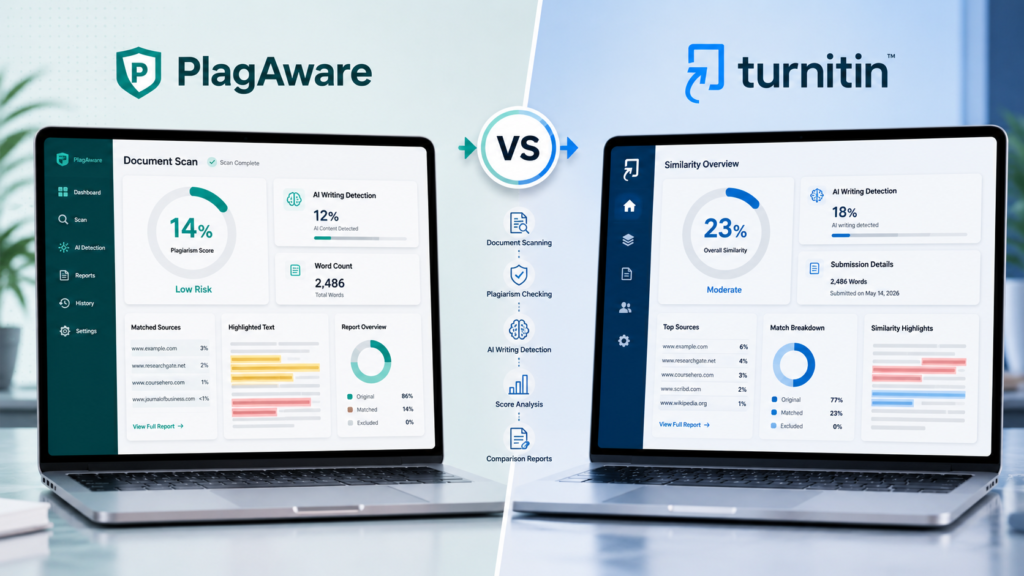
Turnitin is known for having one of the largest collections of essays, articles, journals and web pages on the Internet. This broad coverage means that it can catch copied text from many places – even from sources that are not easy to find using a search engine. Plagaware crawls the web and other public databases, but its reach is not as broad as Turnitin’s. So if you want to compare a paper against a huge collection, Turnitin has an advantage.
Price
Turnitin keeps most of its pricing behind closed doors by dealing directly with schools or businesses. This makes it difficult for someone trying to register on their own. Plagaware, on the other hand, is generally more open about pricing and is often cheaper, making it better for freelancers, small teams, or students who need instant access.
** Capturing AI generated text**
As things like ChatGPT improve and become more common, professors are worried about more than just good old-fashioned copying. Turnitin has added tools to help mark text that is probably written by AI. These tools are not perfect, but they are there. Plagaware is starting to release its own version, but it’s not as proven as Turnitin.
Connections with other tools
Turnitin works with most major learning management systems such as Moodle, Canvas and Blackboard. This makes it easy for teachers to check work as it is submitted. Plagaware doesn’t always connect as smoothly, which may mean a few extra steps to upload or download documents.
Which works best?
If you run a large school or need something that fits the entire university, Turnitin is still your best bet. A huge testing pool, additional tools to capture AI typing, and easy connections to other programs make it a leader in large groups.
But if you’re on a smaller scale, don’t want to go through the sales pitch to get a quote, or just need something you can use occasionally, Plagaware might make more sense. It covers most basic needs and won’t hurt your wallet.
What is Plagaware?
Plagaware isn’t just for teachers or students, it’s a watchdog that doesn’t stop at blogs or open source articles. It delves into the corners of the web that many regular plagiarism checks don’t reach: think subscription-only materials, hard-to-find PDF reports, legal case files, or high-profile medical research journals. This means it can spot copycats from sources that aren’t just on the first page of a search engine.
For this reason, Plagware is chosen not only by schools, but also by law firms, government departments, digital marketers, and freelance writers who may need to check a few documents here and there. No need to sign up for expensive annual contracts – if you just want a small bundle of credits or scan a lot of files at once, you can do it.
For companies with larger needs or wanting to add the tool directly into their workflow, there is an API. This way, plagiarism checks simply run in the background and reports are delivered where people need them without any additional steps. In other words, Plagaware is designed to make rigorous plagiarism checks not only possible, but easy, no matter the field or project size.
What is Turnitin?
Turnitin is widely recognized by colleges and universities as the primary tool for testing academic integrity. It’s not just a simple plagiarism checker, it’s integrated directly into platforms like Canvas, Moodle and Blackboard, so teachers and students can use it without ever leaving their main course site. What makes Turnitin stand out is its huge database: it stores hundreds of millions of past papers, which means it can spot whether students are sharing papers or reusing past year’s essays, something that conventional search engines don’t really pick up on.
In addition to checking whether a student’s work is consistent with material found online or in books, Turnitin also looks for AI-written text and whether the writing style seems inappropriate to the student, similar to digital handwriting analysis. Teachers often use it not only to spot copying, but also to grade and leave feedback in the same place. Combining all these features, Turnitin’s has become a tool in higher education to help catch cheating and help maintain integrity.
Turnitin’s Database: The Student Paper Repository
The real strength of Turnitin is its vast repository of student essays and papers. No other service has anything like it. Papers are submitted by students from all over, and Turnitin keeps a copy before sending it to professors. So if someone is trying to re-use an old essay that was submitted by another student – even from a different school, several years ago – Turnitin is basically the only system with the old version.
In addition, Turnitin has relationships with all the big names in publishing, such as Crossref, IEEE, and Elsevier. This means that he can check the work not only against other students’ work, but also against a wide range of journal articles and research books, things you wouldn’t find online for free.
Turnitin also pulls from what’s online. It scans huge swaths of the web, including pages that may have disappeared over the years. This triple combination of a unique database of student work, intensive publisher relationships, and extensive web crawling puts us well ahead of the competition when it comes to catching plagiarized or recycled work.
Plagaware’s Database: The Depth of the Deep Web
What makes Plagaware stand out the most is that it goes to the corners of the Internet that most plagiarism tools miss. The “22 billion pages scanned” is a flashy number, but what really matters is where those pages come from. Plagaware infiltrates parts of the web that most search engines or other crawlers don’t notice—think password-protected journal articles, members-only medical reports, or even dry legal transcripts and old government PDFs, hiding under forms.
This means that it is much better to catch instances when someone takes text from those hard-to-reach sources. If a student borrows a piece from the average blog or Wikipedia, Turnitin will notice it immediately. But if the copied bit comes in, say, a technical health guideline buried behind a registration wall or a niche legal case, Plagaware is likely to pick it up.
In addition, Plagaware scans live web pages in real time. So if someone tries to use a page that just went up yesterday, Plagaware can flag it before Google or Turnitin even know it exists. Turnitin, on the other hand, is at its strongest when it comes to catching classmates reusing papers or standard internet sources.
In short: If you’re most worried about common student cheating or recycled essays, Turnitin is your best bet. But if you’re looking for secret lifts from private, technical, or professional folks buried out of sight, Plagaware is strangely effective.
The Turnitin Pricing Model
Turnitin is not a tool that you can use as an individual if you expect to check your papers. They mainly work with large groups such as universities and colleges. What happens is that the school buys a license that covers all or most of their students and they pay based on how many full-time students they have.
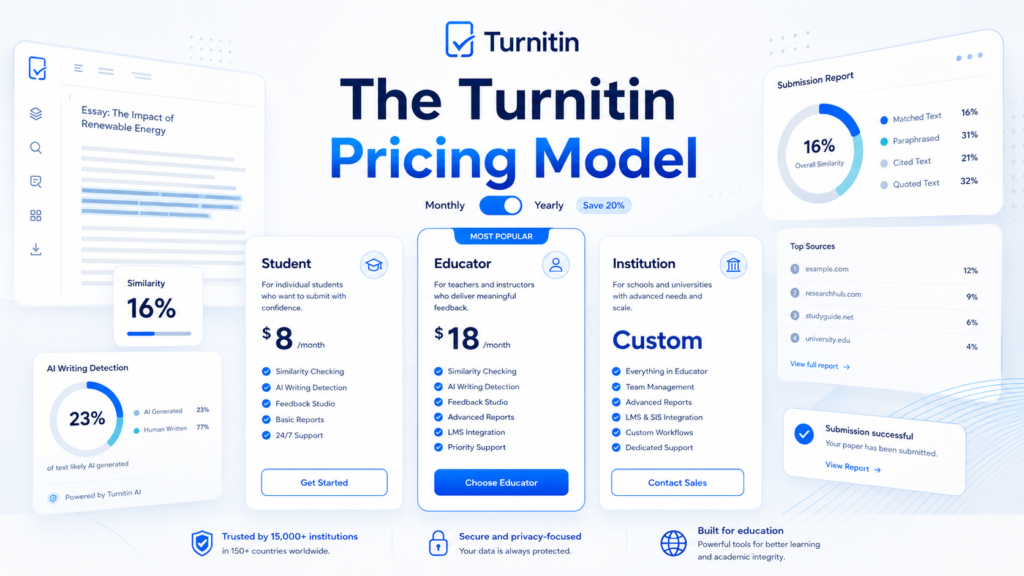
For a school with a few thousand or more students, the cost can jump into tens of thousands, sometimes even hundreds of thousands of dollars each year, depending on needs and size. For that money, they get access to Turnitin’s plagiarism checker, as well as additional tools for providing feedback, checking AI-generated writing, helping students write drafts, and addressing authorship issues.
If you’re not a student or teacher at a school that pays for Turnitin, you generally won’t be able to get your account – there are a few exceptions, mostly in certain countries. So, most people use Turnitin through school or look for other plagiarism checkers if they are on their own.
The Plagaware Pricing Model
Plagaware operates on a simple credit system, making it friendly to people, freelancers, and small groups. You simply buy credits in advance – usually one credit covers one document up to about 20-30 pages. This setup makes Plagaware stand out as one of the better alternatives to Turnitin for individuals, small teams, and researchers who don’t need all the extra bells and whistles.
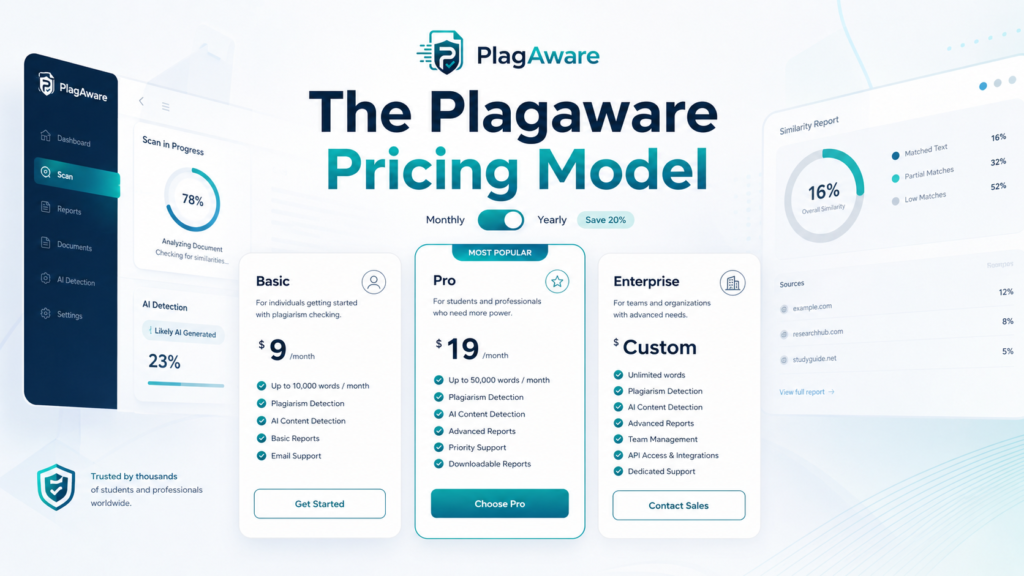
For larger organizations, their bulk plans are cheaper than Turnitin’s because Plagaware adheres to document verification and skips all of Turnitin’s available grading tools.
If you don’t want to sign a long contract, Plagaware’s paid model gives you even more freedom. You can only buy credits when you need them.
So here’s the bottom line: If you’re a solo writer, run a small business, or work at a school that’s watching its expenses, Plagaware is probably the better choice between the two. However, if your university needs a lot of connections to learning platforms and a closed space for student essays, Turnitin’s price, although high, is usually worth it for what it covers.
Choose Turnitin if:
- The feedback studio is your bread and butter. No other tool touches its paper database to capture when students switch jobs—it’s nearly impossible to cheat when work is in the mix.
- When it comes to capturing AI-written or heavily altered text, Turnitin’s double-layered flag (AI flag + paraphrase flag) is still ahead of the pack, especially when students run the text using AI tools to avoid detection. When it comes to academic writing, it raises more red flags than other options right now.
- Assess on canvas or board? Turnitin makes it easy by connecting directly to these systems, so you don’t have to jump between different tabs and logins. This saves serious time every week.
- And if you’re against ghostwriting, Turnitin has an Authorship Study. None of the others offer the kind of background check that allows you to see how a student actually writes and spot work that has been outsourced to a stranger for pay.
- So if your goal is to protect original work, save hours of workflow, and eliminate copy and paste and paid tasks, Turnitin still hits all those marks.
Choose Plagaware if:
- If you’re a content agency or law firm, you probably already know that not all plagiarism checkers are created equal, especially when you’re surfing the web or searching technical databases. Tools for academic focus? Eh, they’re good for essays, but when it comes to commercial content, Plagaware has a definite edge.
- Let’s say you don’t want to mortgage your future with software fees – that’s understandable! With Plagaware, there’s no pressure to sign some huge annual contract just to get started. You pay as you go, which is great if your workload fluctuates from month to month (or, let’s face it, week to week).
- Have a lot of documents you want to scan at once? You’ll love the Watch Folder and automatic zip file extraction features. Seriously, bulk batch scanning makes administrative checks almost fun. Okay, maybe not fun, but less painful.
- And if you’re writing technical white papers or reports that live in those obscure corners of the web—think PDF files hidden deep in forums or dedicated sites—Plagaware’s web crawler shines. It picks up on things that other tools miss, which means you can be sure that your technical content is truly original (and not accidentally duplicating someone else’s hidden work).
Conclusion
When it comes to choosing between Plagaware and Turnitin, it’s like choosing the right tool for the job – are you a university blocking academic papers or someone needing to hunt for plagiarism in the fields of the web? Turnitin is kind of the gold standard for academic institutions, with a lot to do with how schools check for plagiarism, an archive of student work so huge it could make a librarian cry, and all kinds of fancy technology to spot AI patterns or sneaky cheating tactics. But here’s the problem: it’s expensive, locked down, and frankly, unless you’re a university or large school, just getting access is a headache.
Plagaware is different. Think of it as a swiss army knife for everyone else. Its web browsing is ruthless (for example, it’ll find matches even in hard-to-reach corners), pay-as-you-go style pricing will keep you from screaming at an invoice, and batch scanning is a lifesaver if you’re dealing with a lot of documents at once. It’s perfect for content agencies trying to keep their articles original, law firms looking at technical documents, researchers – anyone who wants effective discovery without committing to a huge contract. It also catches sophisticated plagiarism in technical papers surprisingly well, something that some academic tools sometimes lack.
Bottom line: There’s no one-size-fits-all winner here. If you’re knee-deep in academia and struggling with copy-and-paste culture or contract fraud, Turnitin is still your go-to. But if your turf is the fast-paced world of online content or commercial research (or pretty much anything outside of classical education), Plagaware gives you flexibility and power without locking you into an institutional stronghold. Choose what suits your needs – because in this tug-of-war between the two best tools, it’s all about where you stand.