
In the digital world today, keeping your writing original is key. Whether you’re writing essays, blogs, or business papers, it’s important to check if the work is genuine. Two popular tools, Originality.ai and GPTZero, help with this. This article looks at these tools, checking their features, accuracy, and how well they detect AI-written content. We’ll also talk about Bypassengine, a tool made to get past AI detectors, and what that means.
AI-generated content is getting better and better, so we need good tools to spot it. Originality.ai and GPTZero are two big names here. You can use them anywhere in the world on most web browsers, which is handy for everyone. AI-made content is a challenge in areas like schools, publishing, marketing, and law. It’s important to check if content is real to keep trust and honesty, so these tools are becoming more important.
Key Issues and Challenges
Availability and Pricing
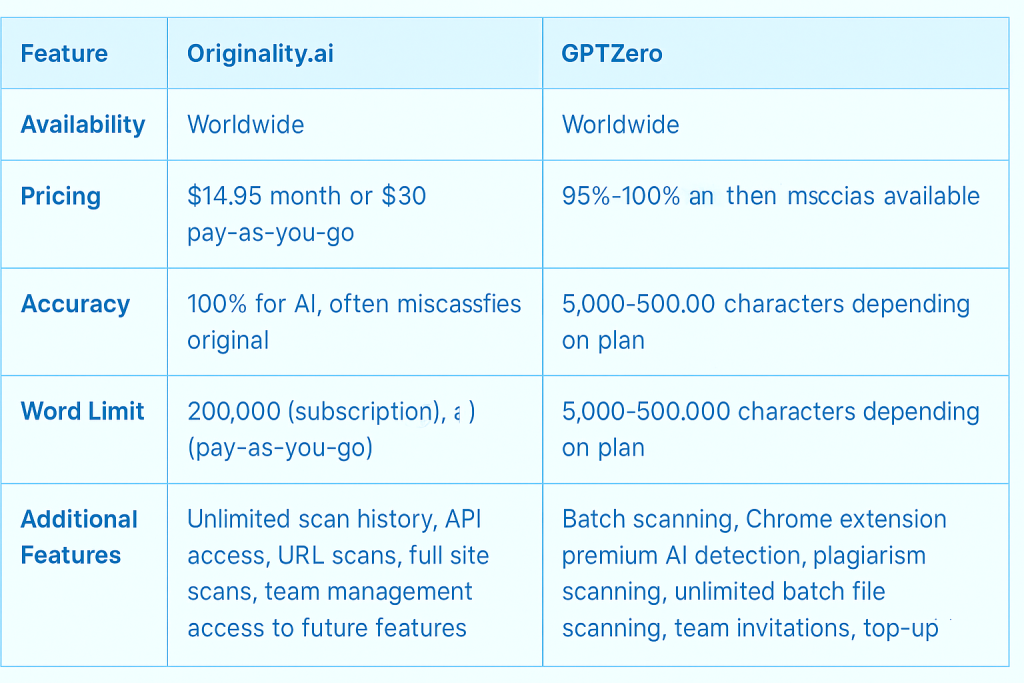
Originality.ai and GPTZero are available everywhere, so many people can use them. Their prices are different, which affects what people choose based on their money and needs. Originality.ai needs a subscription to use, and there is no free version. But, the base subscription is not too expensive, and you can pay as you go if you want to save money. GPTZero, on the other hand, has a free version where you can scan up to 5,000 characters at a time and 10,000 words each month. If you need more, GPTZero has three paid plans that give you more words and features, costing from $15 to $35 a month.
Detection Accuracy
Tools for spotting AI-created content face challenges. Originality.ai says it detects AI content with 100% accuracy, yet it often tags original work as AI-made. It also struggles to tell apart mixed content, failing to separate original from AI parts. GPTZero claims 98% accuracy in spotting AI text, but it too mislabels original and mixed content. Both tools need to improve in catching subtle text differences.
Word Limit and Additional Features
Every tool has its own word limits and features. These affect how good they are for different users. Originality.ai offers a plan for 200,000 words a month. They also have a pay-as-you-go option for 300,000 words, which lasts for two years. Features include unlimited scan history, API access, URL scans, full site scans, team management, and future features. On the other hand, GPTZero has a free plan with a 5,000-character limit per scan. They also offer three paid plans with more characters, from 150,000 to 500,000. The higher plans offer extras like batch scanning, a Chrome extension, premium AI detection, plagiarism scanning, unlimited batch file scanning, team invites, and extra credits.
Comparison Table
Originality.ai vs GPTZero – Solutions and Strategies
Usability and User Experience
AI detection tools need to be easy to use and give a good user experience to work well. Originality.ai is simple to use. It has clear navigation, so even people who aren’t good with tech can use it. Users can start scans fast and see results quickly, which makes the tool efficient. The design is all about being easy to access, so features are easy to find and understand. GPTZero works well but isn’t as simple to use. Its interface looks messy, and important info might be hard to find, so users have to spend more time using it.
Team Collaboration
Team collaboration is key for groups that need to verify content. Originality.ai makes it simple to work together. You can easily add members and assign roles, so everyone can join in smoothly. This is great for schools, publishers, and marketing teams that check content as a group. On the other hand, GPTZero needs each team member to have their own subscription. This makes things harder and costs more, which can slow down efforts and make managing tasks tougher.
Value for Money
AI detection tools need to be worth the money. Originality.ai is good for this. It has many features and fair prices. Both people and teams can use it without spending too much. You can pick a base plan or pay as you go. This lets you fit the plan to your needs and wallet. GPTZero has a free plan, but it does not offer much. Its paid plans can cost a lot, especially for big teams. Even though GPTZero has many features, its cost might not be worth it for those who need to check a lot of content.
Expert Opinions and Insights
Experts say both tools are good. Originality.ai is better for accuracy and features. It finds paraphrased AI content well. This helps keep content honest and spots AI text. GPTZero is great for finding plagiarism, so schools like it. It helps keep schools honest by catching copied work.

Future Directions and Predictions
AI models evolve fast. AI detection tools must keep up. Originality.ai and GPTZero need frequent updates. They must match new AI content tricks. Improvements in detection tech are key. New rivals like Bypassengine add to the challenge. These tools must get better at spotting tricky AI text. Continued development is crucial. They must stay reliable in catching AI-made content.
Recommendations for Bypassing Originality.ai vs GPTZero
For users interested in bypassing AI detection, several strategies and tools can help:
- Prompt Tweaks for GPT: Adjusting the input prompts for AI models like GPT-3 and GPT-4 can also help in bypassing detection:
- Use Diverse Sentence Structures: Vary sentence lengths and structures to mimic human writing styles more closely.
- Include Natural Errors: Introduce minor grammatical errors and colloquial language to make the text appear more human-written.
- Paraphrase Effectively: Change AI-written text with paraphrasing tools before you submit it. Tools such as Quillbot work well for this.
- Blend Human and AI Writing: Mix AI text with human content. Make writing smooth and hard to spot.
- Manual Editing: After creating text with AI, editing it by hand helps avoid detection. This means:
- Changing Key Phrases: Rewording key phrases and sentences to make them unique.
- Adjusting Tone and Style: Matching the tone and style to your usual writing patterns.
- Adding Personal Touches: Incorporating personal anecdotes or insights that AI might not generate.