
Everything on the Internet has changed quickly, especially now that programs can prepare essays or entire reports in seconds. This raises the big question: How can we trust what we read? For schools and businesses, this means that tools that recognize AI-generated or copied text are more important than ever. Two big names keep popping up: Turnitin, which has been around forever and is a staple for teachers and professors, and Originality.ai, which is newer and more focused on webmasters and web content creators.
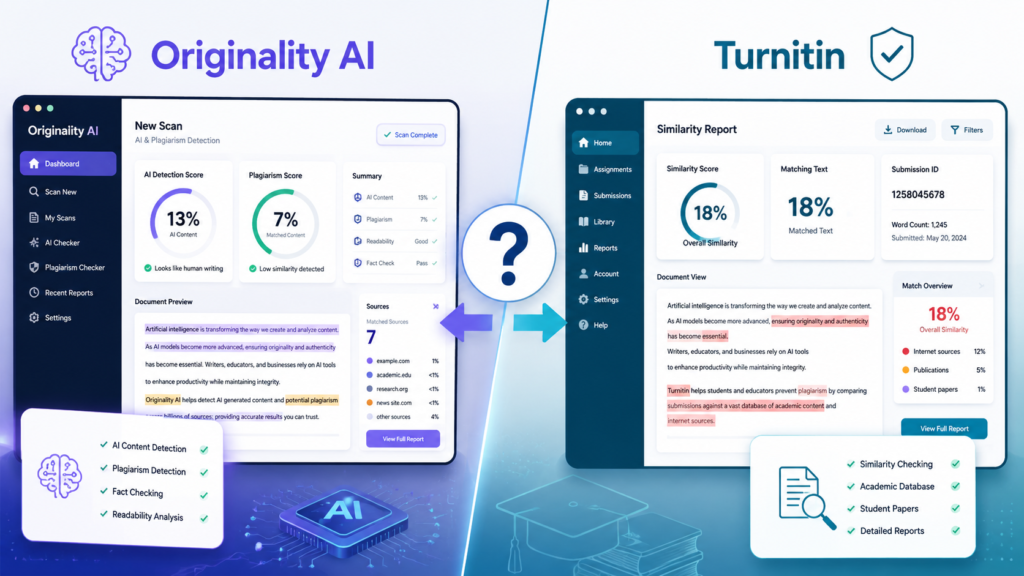
So are they essentially the same? Sort of, but not really. They both check for copycat or AI-generated patterns, but their reasons for existing and what they’re created for couldn’t be more different.
Turnitin is truly designed for colleges and schools. It is important to check that students are submitting genuine original work or are just copying from somewhere else. It compares documents to billions of other documents and websites and even checks how it works by saving everything it receives. Teachers and professors use it to keep students honest and spot cheating.
Originality.ai started with a different crowd in mind. It’s for people who manage websites, blogs, and anyone who cares about Google’s original content rules. Instead of focusing on plagiarism, it also makes it pretty clear where the AI may have written instead of a person. This helps web owners ensure that their content is listed in search engines and doesn’t raise alarms with Google.
The Core Overlap: Plagiarism and AI Detection
If you zoom out, it looks like Originality.ai and Turnitin are doing the same thing: verifying that someone’s work is really theirs. Both are online services; you upload a document and they run it through their systems and then give you a percentage so you know how much of that text matches something else.
Where they really go in different directions is what they are really looking for. Turnitin focuses on detecting plagiarism, so it checks your writing against a huge collection of student papers, websites, journals, and books to spot plain old plagiarism. If you pasted something from Wikipedia or got ideas from another student, Turnitin will probably pick it up.
Originality.ai, on the other hand, is more designed for today’s problems, such as catching things written by bots. Its purpose is to tell if the writing was generated by AI tools or if a human actually sat down and wrote those words. So while Turnitin is great for marking copy and paste jobs, Originality.ai is better at figuring out if something “sounds human” or if it’s a machine.
The Convergence of Two Worlds
Why is everyone suddenly comparing Turnitin and Originality.ai in 2026? It’s pretty simple: Turnitin, once a teacher’s go-to for sniffing out plagiarism, has now entered the AI detection game full force. This has been Originality.ai’s playground since day one. Now these tools have started to tame elbows and offer almost the same features:
- AI Detection: Both platforms claim to be able to detect content created by the latest LLMs such as GPT-4o, Claude 3.5 or Google Gemini.
- Plagiarism Check: Everyone checks your writing for enough sources to make your English teacher turn heads.
- Similarity Score: You’ll get a neat percentage showing how much your document matches existing stuff.
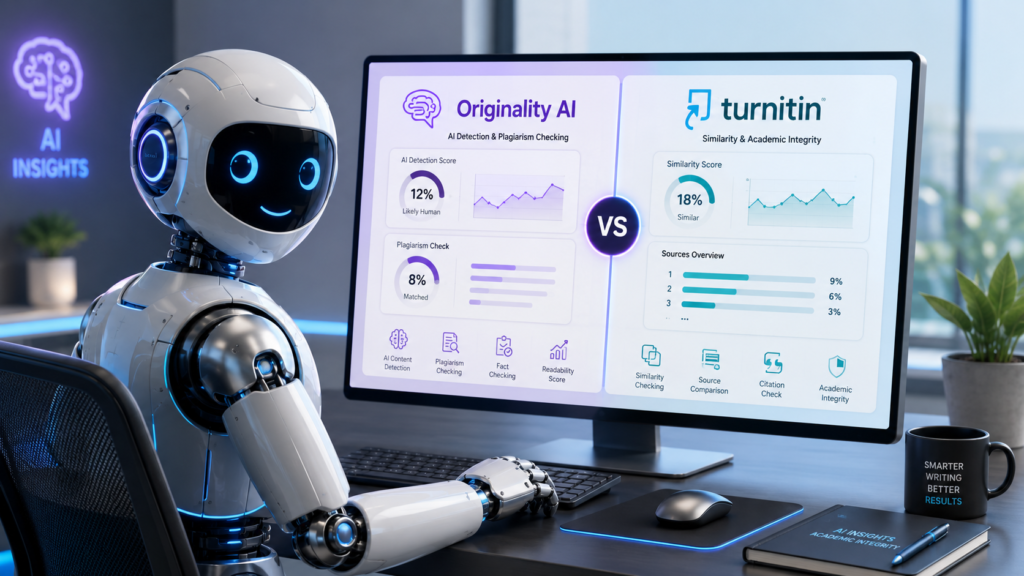
So, of course, if you squint, they look almost interchangeable. But honestly? It’s as silly as saying that a chef’s knife is “essentially the same” as a surgeon’s scalpel, because both are sharp and cut. The truth is, they’re designed for different people (think: teachers and web publishers) with different jobs in mind, and they produce different results depending on how you use them. The coincidence is real, but the goal? Not even close.
Deep Dive: Architecture, Database, and Detection Methodology
To truly answer how does Originality.ai compare to Turnitin, we must look under the hood at their detection engines and databases.
Turnitin: The Academic Fortress
The real strength of Turnitin is its massive, locked database. For more than two decades, she’s been collecting student work and quietly building a giant archive of essays that aren’t publicly posted or Googled. When you submit a paper to Turnitin, it checks your work against:
- Huge store of essays and assignments from thousands of schools.
- Selected articles from magazines, books and journals – academic sources that you can use for research.
- Part of what’s available on the wider web.
A recent innovation is Turnitin’s AI checker, which looks for traits common in bot-generated writing. It’s trained to spot things like rigid, template-like setup, missing or shallow critical thought, or text that jumps between language styles (revealing that it’s written by a robot). Most importantly, Turnitin doesn’t work as an additional program that you have to open yourself. Instead, it’s integrated into classroom tools like Canvas or Blackboard. Students submit their papers as normal, and behind the scenes, Turnitin performs its own verification without any additional steps for the teacher. As such, it blends into the regular flow of homework and assessments, much like other built-in school tools, rather than feeling like an add-on.
Originality.ai: The Web Publisher’s Guardian
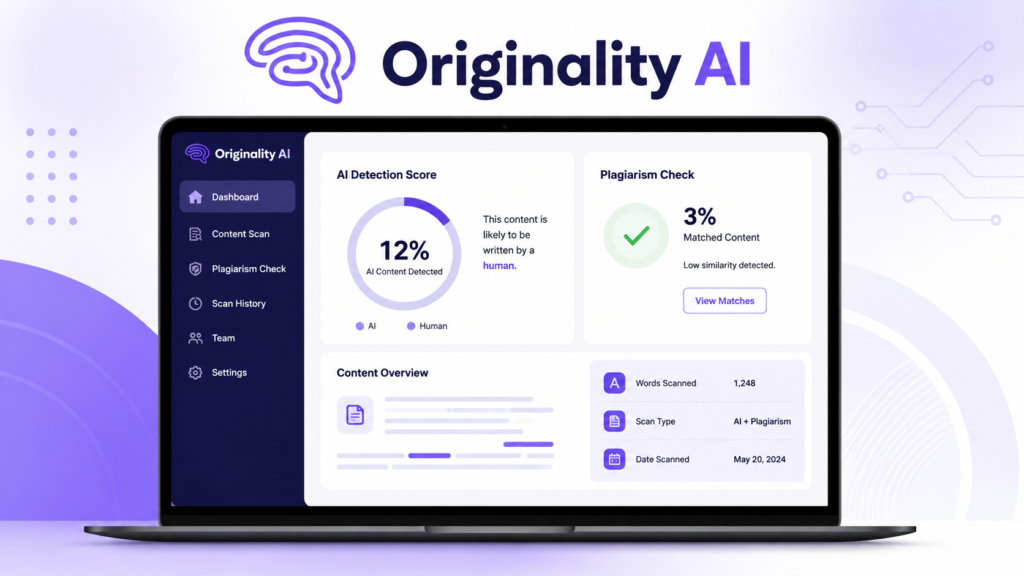
Originality.ai was built with the needs of web publishers, content creators and SEO professionals in mind. Its main task is to help people spot copycats, check for AI, and flag anything that looks bad or possibly fake. If you’re blogging, paying freelancers, or curating web content for clients, you want to make sure what you’re posting is real, unspoiled, and accurate.
There are a few differences in how Originality.ai works compared to other tools like Turnitin:
Better crawling of web content: Originality.ai’s bots are designed to scan public websites much more aggressively and more frequently than what you get with tools designed for research papers or schoolwork. This means it will find copied parts from recent blog posts, news articles, or content that has just been published—things that Turnitin might miss because they aren’t in academic collections or haven’t entered their system yet.
Text and Image AI Detection: This is where Originality.ai really steps up on the web. It checks both written text and images for AI fingerprints. In other words, it will tell you if the image likely came from a generator like Midjourney or DALL-E 3, or if the writing sounds like ChatGPT or another AI. Turnitin, on the other hand, only looks at text and focuses on catching cheaters in schools.
Fact Check Help: Another thing that is very modern. Originality.ai can flag claims that may be incorrect by quickly checking what’s currently online. If you make a factual claim in the article, it will highlight anything that looks suspicious or out of date. Turnitin does not; it just checks if something has been copied or likely made by someone.
So, while Turnitin is good for teachers and students, Originality.ai caters to the needs of web publishers and digital marketers who care as much about truth and fresh content as originality.
The Most Critical Distinction: False Positives and Paraphrasing
Originality AI and Turnitin are actually quite different, especially when it comes to how they display results and how they work best.
Turnitin is quite strict about capturing text that has been submitted using tools like QuillBot or Undetectable AI. It doesn’t just look for outright plagiarism, its algorithms also look for writing that was likely created by an AI and then tweaked slightly by rewording. For teachers and schools, this is exactly what they want, so it’s a feature, not a bug. But if you’re, say, a marketer or someone who uses writing tools to clean up AI-generated drafts, Turnitin can be risky. If it marks your work, even if you’ve made a ton of changes, you could end up with awkward questions you don’t want to answer, or worse, lose the client’s trust.
Originality.ai, on the other hand, is designed with more of a “writers using AI” vibe in mind. Its systems are trained on both pristine AI output and subjects that have been rephrased. Also, the way he presents his findings is much more detailed. You get a sentence by sentence, so if there’s a place that looks suspicious, you’ll know exactly where. This puts the final call in your hands instead of just putting a big red flag on your job. This is useful for people working in content creation, publishing and agencies, where human input is mixed with AI drafts and some refinements and decisions are inevitable. At the end of the day, the biggest difference is context—Turnitin has zero tolerance, while Originality.ai offers more flexibility for real-world, professional writing.
Conclusion
When you question whether Originality AI is like Turnitin, you’re asking whether a calculator is the same as a calculator—they both work with numbers but are designed for different jobs.
At first glance, 2026 the two programs may look quite similar. You can see the scores, you can see the color accents, and you can feel if something is “authentic” or not. So someone just looking at both might think, “Hey, they’re doing the same thing.” However, this is not the case.
Turnitin is still the standard in classrooms and colleges. It occupies a unique place in education. Its biggest strength is its huge library of essays and past assignments, and how well it fits into the platforms that students and teachers already use every day. Schools depend on things to be honest and fair, checking your work against years of student writing that isn’t available anywhere else.
Originality AI, on the other hand, was designed with newer types of writing in mind: think blogs, web articles, and yes, checking if a chatbot has written something. Its purpose is to detect content that may have come from a machine rather than a human. It’s convenient for writers, editors, and webmasters, but it doesn’t have the huge private collection of school papers that Turnitin has.
So if you look at the surface, the overlap is there, but each tool delivers something completely different. Schools and teachers still rely on Turnitin for essays and research, while publishers and website owners can turn to Originality AI when they’re worried about computer-generated text floating around the web. Both try to keep things fair, but they guard very different doors.