
GPT-4 is a tool for making text. It is very advanced. It has many uses like in schools, ads, and news. People want to know if GPT-4 or a person wrote something. This guide shows how to find out, what tools help, and why it’s important.
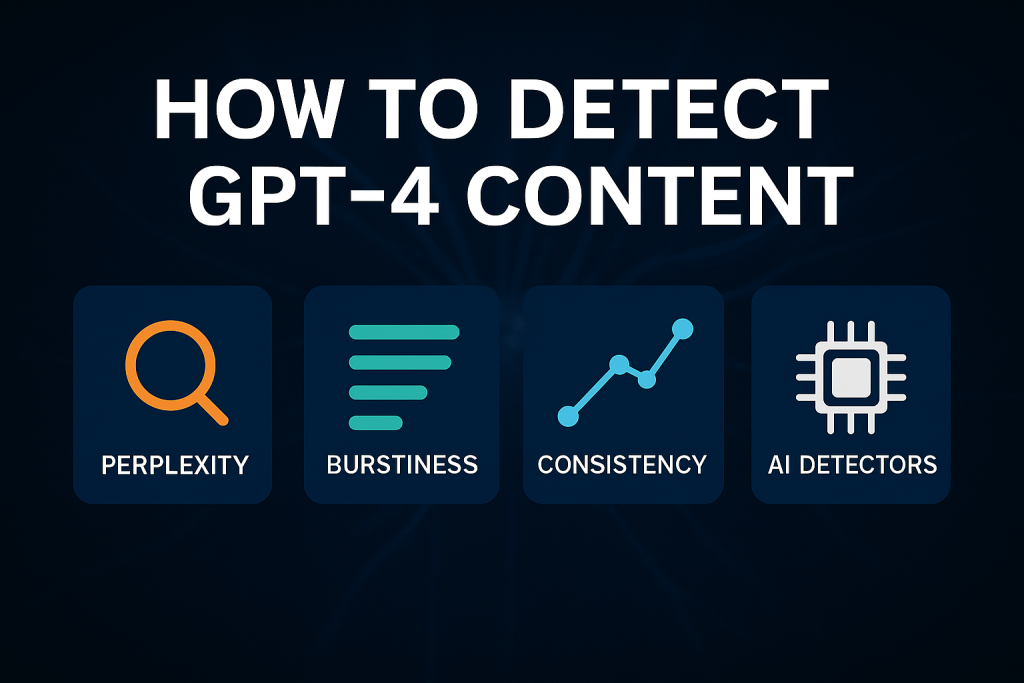
Finding GPT-4 content helps with trust and ethics. People want to know if AI wrote something for these reasons:
Academic Integrity
Teachers want students to show their own knowledge and thinking. GPT-4 can write great essays, but schools need to check that students’ work is truly theirs.
Journalism and Media Authenticity
Journalists and editors check who wrote it. This stops fake news. Knowing if GPT-4 helped makes sure news is real.
SEO and Marketing Compliance
Businesses want their content to be helpful. Google and other platforms like it when content is good. If content seems low-quality or made by AI too much, it can be penalized. Detection tools help businesses keep their rankings and avoid problems with algorithms.
Characteristics of GPT-4 Generated Text
To spot GPT-4’s writing, you need to know its style. It’s powerful but has signs you can notice.
- Fluent but predictable phrasing: GPT-4 often selects safe, high-probability words.
- Even sentence rhythm: Less variation in sentence length and complexity.
- Repetitive structure: Sentences may echo each other, especially in longer text.
- Over-explaining: GPT-4 tends to explain things too much to be “helpful.”
Human vs GPT-4 Writing – Key Differences
Comparing human writing to GPT-4 reveals subtle differences:
- Sentence variation: Humans change their tone, speed, and sentence length. GPT-4 keeps things more even.
- Creativity: Human writers use surprising comparisons and feelings that AI might not notice.
- Contextual adaptation: GPT-4 excels with prompts. It may struggle with keeping long stories consistent.
- Emotional nuance: GPT-4 acts like it understands feelings but doesn’t have real experiences or deep emotions.
Technical Methods to Detect GPT-4 Content
GPT-4 acts like it understands feelings but doesn’t have real experiences or deep emotions.
Perplexity and Burstiness
Perplexity shows how hard a text is for a language model to predict. Text from GPT-4 is often less puzzling because it’s likely. Burstiness looks at changes; human writing often has more changes.
Probability and Token Analysis
AI tools look at text parts and check how likely each word is from AI. If many words seem “likely,” it might be AI-made.
Linguistic Fingerprinting
This method checks sentence structure, grammar, and writing style to create a distinct “signature” for AI-written content.
Best AI Detectors for GPT-4
Here are some of the top tools currently at the forefront of detecting GPT-4 content:
- GPTZero: A reliable education platform, known for its varied content and complexity measures.
- Originality.ai: Widely used by SEO professionals and bloggers, it identifies both AI-generated content and plagiarism at the same time.
- Turnitin AI Detector: Integrated into learning platforms, used by many universities.
- Copyleaks AI Checker: Multilingual help and clear UI.
- Undetectable AI: Offers tools rewrite and shows AI hidden, not always for detection, but helpful side-by-side analysis.
How These Detection Tools Work
Every tool uses its own mix of language processing, stats models, and machine learning. Usually, they:
- Tokenize the input text
- Measure sentence structure, probability distributions, and linguistic cues
- Score the text on a likelihood scale (e.g., 0%–100% AI probability)
- Offer a report with flagged sections and confidence indicators
Use Cases in Academia and Publishing
In 2025, GPT-4 detection tools are widely used in:
Academic Essays
Educators check if work is original, especially for homework.
Admissions Essays
Colleges check statements to make sure students wrote them.
Journalism
Editors check if reporters use AI to write without saying so.
Digital Publishing
Websites check freelance work to prevent SEO issues and false info.
Legal and Ethical Considerations
Detecting GPT-4 content brings up big ethical questions:
- Privacy: Are students told if someone scans their work?
- Consent: Detection without permission can break rules.
- Intellectual property: Who owns GPT-4 content made by a paid writer?
- Bias: Are tools marking non-native English writers wrongly?
Clear detection practices are key for fair use.
False Positives and Limitations
Detection tools help, yet they’re not flawless. They can:
- Incorrectly labels human-written content as AI-generated (false positive).
- Fails to detect hybrid content (AI-generated text edited by humans).
- Struggles with very short or heavily edited content.
- Have difficulty handling multilingual or poetic writing.
Knowing limits matters before you decide based on results.
Tips To Improve Detection Accuracy
For more accurate and dependable results:
- Use multiple tools: Cross-checking helps minimize false positives.
- Analyze in segments: Using shorter samples enhances the model’s focus.
- Look beyond the score: Incorporate human review to provide context for the results.
- Flag rewriting patterns: Writing that feels overly polished or generic might be influenced by AI.
How Developers Detect GPT-4 Content
Detection in tech setups usually occurs at the infrastructure stage:
- API Log Tracing: Developers watch what content GPT-4 APIs make.
- Metadata Tagging: AI-generated content might contain embedded or hidden markers.
- Usage Patterns: Repeated prompts or consistently uniform writing sessions may indicate automated generation.
Big companies like Google, Substack, and Notion are adding detection tools to their systems.
The Future of GPT-4 and AI Content Detection
As GPT-4 and soon GPT-5 get smarter, detection tools must improve too.
- Watermarking: OpenAI and others look into unseen marks in made-up text.
- Open Standards: An industry rule might set how to tag AI content.
- Blockchain for Provenance: A timestamped content history can help verify authorship.
- Adaptive Detection Models: AI detectors that adapt and improve in real time.
In the future, being open and giving users power will shape things.
Final Thoughts on Detecting GPT-4 Content
Finding GPT-4 content isn’t just about catching cheaters. It’s about trust and knowing how AI fits in our online lives. While no tool is perfect, mixing detection with human judgment is the best way forward.
Writers should say when they use AI. Editors and teachers should look at detection results with context. Developers should keep making tools that work well and are fair.
FAQs – How To Detect GPT-4 Content
Can GPT-4 content always be detected? Detection can make mistakes, especially with short or mixed content.
Is using detection tools legal? Yes, content creators need to know. Privacy laws differ by area.
How do I avoid false positives? Use tools, know limits, and check results by hand.
Are detectors accurate for mixed content? When human and AI writing mix, accuracy can drop. Be careful with borderline results.
Will GPT-5 be harder to detect? Yes. Future models need better detection strategies.