
When crafting an essay, it’s important to recognize that you’re not only offering your own thoughts but also building upon the contributions of others. To do this appropriately, it’s crucial to cite sources correctly. Proper citation shows readers the origin of your information, helps prevent plagiarism, and adds credibility to your work.
Simply put, you need to include in-text citations (brief references within your essay) and a works cited or bibliography page at the end. The specific format will depend on whether you’re following MLA, APA, or Chicago style, which you can look up in detail at Purdue OWL, a highly reliable citation guide online.
For students concerned about plagiarism checks, tools like Walter Writes for Students can assist in refining your essay to make it sound more natural and avoid incorrect AI detection.
What Are Citations in an Essay?
Understanding the Purpose of Citations
A citation shows where facts in your essay came from. It’s like a path back to the source, making your thoughts clear and trustworthy. In academic papers, you find citations in two spots.
- In-text citations – In your essay, you can add short citations, like using MLA style, which might appear as (Smith 23).
- Works cited or bibliography page – List every source you used and put it at the end of your essay.
Quoting sources isn’t just about sticking to guidelines. It shields you from accidental copying, bolsters your points, and shows your paper is supported by solid research. For instance, the MLA Style Center notes that citations serve as a guide for readers keen to explore your references further.
If this is all new to you, don’t fret. Tools and guides, such as Walter Writes for Students, can help you grasp citation rules and ensure your essay clears plagiarism scans on sites like Turnitin.
What Needs to Be Cited in Your Essay?
If the thought, fact, or phrase isn’t yours, you need to give credit. However, not all things need sourcing, so understanding when to do so matters.
You must cite when you use:
- Direct quotes – Taking words directly from a book, article, or website.
- Paraphrased ideas – Rephrasing another person’s ideas using your own words.
- Statistics or data – facts, graphs, or study results.
- Unique theories or arguments – An idea that originally comes from a different writer.
You don’t need to cite
- Common knowledge – The Earth goes around the sun. This is a well-known fact that no one argues about.
- Your own thoughts or analysis – Your own unique interpretations and insights.
When unsure, it’s better to cite than risk plagiarism, according to the Harvard Writing Center. Citing sources makes your essay stronger by proving thorough research.
If concerned about Turnitin or other detectors, Walter’s guide offers tips on balancing originality with correct references.
How to Cite Sources Correctly in an Essay
When you cite someone’s work, you need to do two things each time.
- Insert an in-text citation – In your essay, include a brief citation to show the source. For example, MLA style uses (Smith 23), and APA style uses (Smith, 2020, p. 23).
- List the full source details – For your works cited or reference list, include the author’s name, the title, the publisher, and the date.
Example
- MLA in-text citation → (Orwell 45)
- MLA works cited entry → Orwell, George. 1984. Penguin, 1950.
The APA Style Guide emphasizes the importance of being consistent, as even tiny formatting errors can lose you points. If this seems daunting, try free tools like citation generators, but make sure to verify them with official style manuals or reliable sources like Purdue OWL.
Here’s a tip: If your professor uses plagiarism checkers, it’s crucial to cite correctly and refine your writing with a tool like Walter Writes for Students to ensure it remains original and flows naturally.
Different Citation Styles and When to Use Them
There are several ways to cite sources, and the method you choose depends on the subject and what your professor wants. Here are the three most common styles:
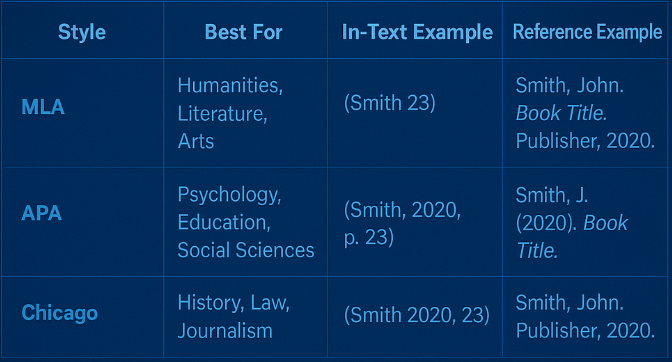
- MLA (Modern Language Association) – The text works well for essays about literature and the humanities.
- APA (American Psychological Association) – The text is often found in social science studies.
- Chicago style – It’s popular in history, law, and publishing since it provides footnotes and author-date choices.
You can look for complete guides at the MLA Style Center, the APA Style Guide, and the Chicago Manual of Style.
If you don’t know which one to pick, ask your professor. Usually, MLA is for humanities, APA is for sciences, and Chicago is for history and publishing.
In-Text Citations vs. Reference List Citations
When crafting an essay, you need two kinds of citations: in-text ones and a reference list. Both are crucial and serve different roles.
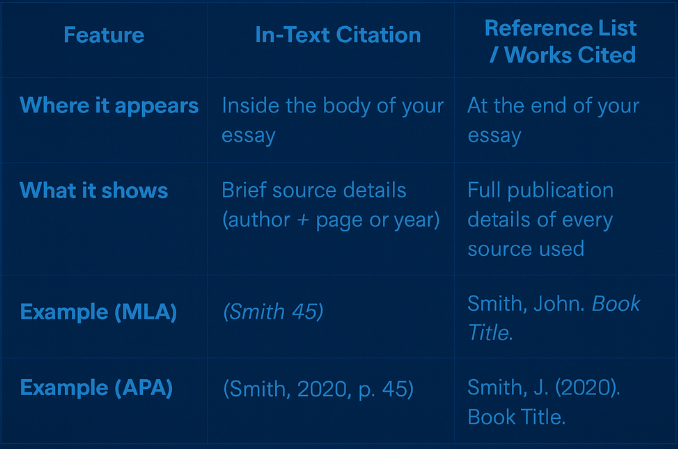
Picture it like this: in-text citations act like signposts, while the reference list serves as a complete map. A signpost offers a brief direction (“Smith, p. 45”), but the map at the end (your bibliography) tells readers exactly where to find that source.
The Purdue OWL emphasizes that forgetting either part can weaken your essay; readers need both the quick markers and the full roadmap.
If you’re unsure if your formatting seems natural, Walter’s guide on making your essay undetectable shows how to refine your writing while keeping citations intact.
Common Citation Mistakes & How to Avoid Them
When students know how to cite, little mistakes might still cause them to lose points or face plagiarism issues. Here are errors to avoid and ways to correct them:
Forgetting in-text citations
A lot of essays have a bibliography, but they leave out the in-text citations. If you don’t have both, your essay seems unfinished.
- Ensure each source in your reference list matches an in-text citation.
Mixing citation styles
Mixing MLA for one source and APA for another can make your essay seem untidy.
- Choose one style, like MLA, APA, or Chicago, and use it all through your essay. You can trust the MLA Style Center and APA Style Guide for help.
Incorrect formatting
Mistakes like leaving out italics, using incorrect punctuation, or skipping page numbers are easy to notice.
- Make sure to verify with reliable sources such as Purdue OWL or a citation tool. However, don’t just copy and paste; always check the final layout.
Over-citing common knowledge
You don’t need to back up every fact. Saying “The Earth goes around the sun” just fills up your paper.
- It’s essential to know the difference between general facts and study results. The Harvard Writing Center offers a clear guide on this.
Relying only on citation generators
Tools are useful, yet they might incorrectly place commas, italics, or page numbers.
- Begin with these and check each one yourself.
If you’re concerned about plagiarism checkers like Turnitin, take a look at Walter’s guide for students on avoiding false AI flags. It explains combining proper citations with natural writing that goes unnoticed.
Methods to Avoid Plagiarism in Essays
Sometimes, students accidentally copy others because they don’t know how to use sources properly. The bright side is that there are simple ways to keep your work unique and safe for academics.
- Cite every source properly
When you borrow words, thoughts, or facts from another author, you need to add an in-text citation and list it fully in your works cited or reference section. Sticking to a style guide like APA or MLA helps keep things accurate.
- Paraphrase instead of copying
Instead of copying sentences exactly, express the concept using your own words. The Harvard Writing Center suggests paraphrasing to show comprehension and minimize excessive quoting.
- Use quotation marks for direct quotes
When you directly use an author’s words, enclose them in quotation marks and cite the source. This shows what you wrote versus what was written by someone else.
- Keep track of your sources while researching
Students often mess up by forgetting where they got a fact or stat. A basic notes file or citation tool can help avoid stress later.
- Run your essay through a plagiarism checker
Even if you feel sure, a fast review might show missing sources or unintentional similarities. Many people use tools like Turnitin, but pairing them with humanizing tools like Walter Writes helps your essay sound natural and avoid AI detection.
How Walter Writes AI Helps with Citations and Originality in an Essay
Even if you stick to all the guidelines, essays might still be caught by plagiarism or AI detection tools. That’s where Walter Writes AI steps in. It’s not just a simple rephrasing tool; it’s made to ensure your writing feels human, flows naturally, and remains unique, all while keeping your references accurate.
Here’s how Walter Writes helps students:
- Keeps your citations safe – Walter keeps your MLA, APA, or Chicago style citations intact, unlike paraphrasing tools that remove or change them, while improving the rest of your essay.
- Avoids false AI flags – Many tools, like Turnitin, check for AI-generated writing. Walter changes your essay so it gets through these checks while keeping your style.
- Improves readability – Your essay will not only be “safe,” it will also have a smoother flow, using different sentence patterns and a more natural rhythm.
- Supports academic integrity – Walter emphasizes integrity. It aids in articulating your thoughts clearly while ensuring you acknowledge your sources properly.
Students who use proper citations alongside Walter’s rewriting tools create essays that are both credible and truly unique. To see it in action, try the student-friendly tool: Walter Writes for Students.
Improving Workflow and Originality
Properly citing sources is just one step in crafting a strong essay. Another major hurdle for many students is handling the workflow. This includes managing research notes, drafting, revising, and ensuring originality. The right tools and habits can significantly impact this process.
A seamless way to write an essay might unfold like this:
- Research and collect sources – Make a list of all the articles, books, or websites you intend to reference.
- Draft your essay with placeholders – Make brief notes such as (Author, page) to remember citations later.
- Format your citations – To turn those placeholders into correct MLA, APA, or Chicago style citations, refer to a reliable source such as Purdue OWL.
- Polish for originality – To enhance your draft, consider using a tool like Walter Writes. This can help smooth out your writing, make it sound more natural, and reduce the risk of AI plagiarism detection.
Combining proper citation habits with originality tools helps save time and lessens stress. Rather than stressing if Turnitin will flag your paper or if it seems AI-generated, you can concentrate on your thoughts.
Ultimately, being original isn’t about writing alone. It means sharing your viewpoint while using others’ work wisely. By simplifying your process and keeping citations accurate, your essay will not only meet academic standards but also truly reflect your voice.
FAQs About Citing Sources in Essays
What is the easiest citation style for essays?
The choice depends on what you’re studying. Lots of students think MLA is simpler since it just uses an author-page format like (Smith 23). But, if you’re in social sciences, APA might be a better fit. For history and law papers, Chicago is often the go-to style.
Do I need to cite sources if I paraphrase?
Certainly! When you rephrase an idea, the concept still remains the property of the original creator. It’s essential to provide an in-text citation whenever you paraphrase.
Do I have to cite common knowledge?
Facts everyone knows, like “The Earth goes around the sun,” don’t need a source. If you’re not sure if something is well-known, it’s better to cite it.
Can I use citation generators for my essay?
Sure, but be careful. Tools such as EasyBib or Citation Machine help save time, but they can have errors in formatting. Make sure to always verify your references using reliable sources like Purdue OWL.
Master Citations and Keep Your Essays Original
Citing sources doesn’t need to be scary. Once you learn what to cite, the right format, and the style required, it starts to feel normal. Avoiding plagiarism is about being open with your sources and making sure your paper shows your research and your own ideas.
Walter Writes AI can help you with this. It makes your writing sound natural, keeps your MLA, APA, or Chicago citations correct, and ensures your paper passes checks for plagiarism and AI detection. Rather than worrying about issues on Turnitin, you can concentrate on delivering an essay that is genuine, reliable, and truly yours.