
You are not alone if you have fallen into that endless pit of online answers about Turnitin and translation. It gets confusing quickly – one swears that Turnitin can sniff out even a single translated phrase, others claim that automatic translators are a reliable disguise. Right? It’s not as black and white as it seems on the forums.
Let’s cut the noise. Turnitin doesn’t really have a separate function just for retrieving translated materials. There’s no big shiny “translation warning” going on behind the curtain. But that doesn’t mean you’re in the clear if you run something through Google Translate and present it as your own. Here’s why:
Turnitin works by comparing what you submit against a vast repository of student essays, journal articles, websites, and books in multiple languages. If you’re translating content directly from, say, Spanish to English, certain unique phrases, sentence patterns, or rare word pairs (think n-grams, basically small chunks of language that stand out) may end up in a familiar pattern. This activates Turnitin’s similarity report. Sometimes, especially with a literal translation or a not-so-good machine translation, the system notices strange phrases that don’t make sense. This marks your document, giving the instructor a reason to take a closer look.
But there’s another layer: A lot of what Turnitin finds is based on frequency and rarity. He can brag when structures or chunks of words appear more than they should. This means that if you lift large chunks from another language and carefully translate them, you can still catch it.
Of course, the key question is not just about “detection,” but about what counts as fair academic practice. Even if you manage to sneak something through the software, it can be a slippery slope to treat the translated writing as your work. Schools are just as concerned with work ethic as they are with technical details.
So what is the fair way forward? Use different research sources, study the topic, write down your opinions and cite any original material, even if you find it in another language. If you ever need to translate, say things in your own voice and mention where it came from.
What is Turnitin and How Does Its Detection Software Work?
Okay, before we dive into how Turnitin handles translated text, it’s worth clarifying what Turnitin actually does. Most people just think of it as a plagiarism detector and call it a day, but that’s just scratching the surface. Think of Turnitin more like a set of tools that plug directly into your university’s online platform. When you submit a task, your work doesn’t just run through a one-time checker; instead, it is analyzed from multiple angles.
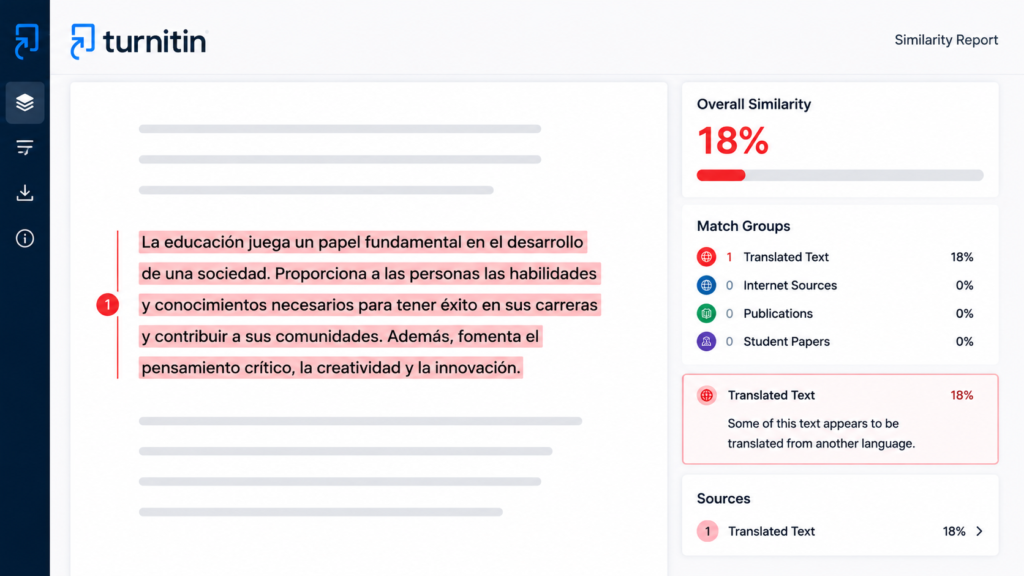
First – and probably what everyone knows – is the similarity check. Here’s where Turnitin flexes its muscle: it scans what you’ve written against this incredibly large private database of billions of web pages, piles of old student reviews from schools around the world, and stacks of academic journals. The bottom line? If the database finds parts of your work that match the subjects, those parts will be marked. At the end, you’re left with a similarity score, a small percentage that tells the professor how much your writing matches existing sources.
But Turnitin didn’t stop there. Recently, they have moved to a newer layer: AI writing detection. It’s not just about copying, Turnitin now pays attention to how things are written. It looks for clues that a computer pumped out the content, not a human (think excessively neat sentences or a rhythm that never breaks). Here’s the twist: This AI detection tool is trained to sniff out patterns in English, which makes it interesting (and maybe risky) if your text starts in another language and has been translated into English.
Finally, there’s one part that never changes: your instructor. Turnitin can pop up all kinds of statistics or alerts, but ultimately it doesn’t make any final calls itself. A high percentage of similarity or the label “Suspected AI” is more of a flag for a professor to take a closer look at. They’ll use their own judgment—perhaps comparing it to stuff you’ve submitted before—and dig into the Turnitin report before making any decisions about whether you’ve broken the rules. Because of this step in the human cycle, running your essay through Google Translate doesn’t automatically mean you’ve escaped detection.
Does Turnitin Detect Translated Text from One Language to English?
Okay, so let’s see what actually happens if a student takes a Spanish paper, runs it through something like Google Translate, and makes that English text their own.
First: If the original Spanish text is already in the Turnitin collection (or was submitted by another school, or is online and easily found), here’s how it works. Turnitin isn’t just about matching phrases – they look at sentence structure, paraphrased ideas and the ‘shape’ of your writing. Automatic translators like DeepL or Google Translate tend to translate each sentence quite literally, keeping grammar, order and even punctuation awfully close to the original. So even if your English doesn’t look word-for-word identical, Turnitin can often tell that it’s related to the original Spanish. Your teacher can get a report along with your English and Spanish matches, and it’s very obvious that you’ve just switched languages. Nothing clever here – just copied work dressed in a new language.
On the other hand, let’s say your resource is hidden—perhaps it’s in a forum that requires a password, or it was posted five minutes ago and Turnitin hasn’t noticed it yet. In this case, Turnitin probably won’t mark your work and you may come back with an extremely low similarity score. It feels safe, but it really isn’t – like copying a friend’s homework but doing it quietly behind the teacher’s back. You still don’t deliver what you wrote, even if it tricks the software.
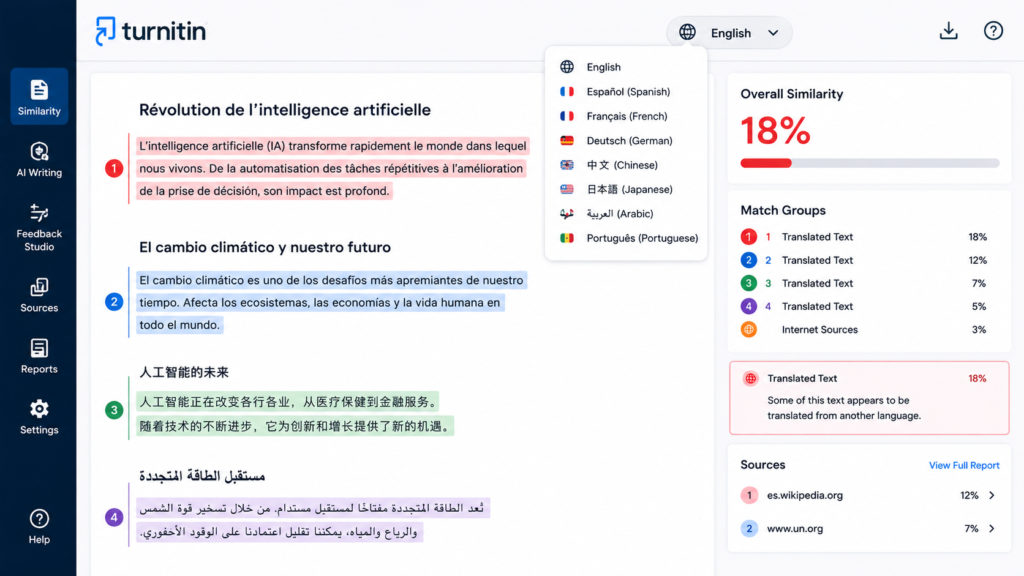
Here’s the kicker: the translated text doesn’t really feel like natural English. Automatic translations usually sound awkward – perhaps the choice of words is strange or the phrasing does not correspond to how a native speaker would write it. This style stands out, and some teachers or AI detection tools pick up on those odd patterns. It can be labeled as AI-generated or as something copying and pasting, even if Turnitin doesn’t match it with anything.
Can Turnitin Detect Google Translate? A Deep Dive into Machine Translation
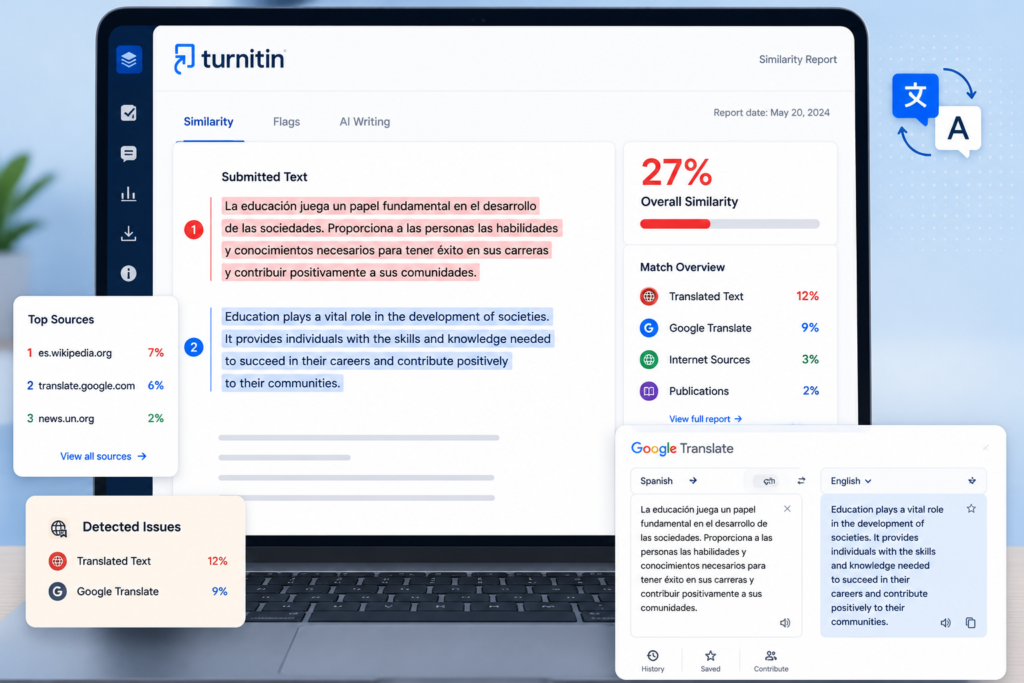
The tool you choose really matters, and Google Translate is everywhere. People often ask: Can Turnitin location text be displayed using Google Translate? There’s a lot to unpack here, especially since machine translation has changed a lot over the years.
If you go back a decade or so, Google Translate was very awkward. It featured sentences that sounded awkward or just plain weird in English, things the teacher noticed within a second. But the newer version, which uses neural networks instead of phrase-by-phrase, makes translations much smoother and more natural-sounding.
But here’s the funny part: because this kind of translation is so accurate and so widely used, it can actually make life easier for plagiarism software like Turnitin. The app isn’t magical—it can’t “see” the translation itself—but when many students take, say, a Chinese article and submit it to Google Translate for their homework, everyone ends up with pretty much the same phrasing and sentence structure. Everyone seems to be wearing the same uniform. So if Turnitin sees a bunch of papers with an almost identical English structure, that’s a big red flag.
Also, while the translations are much better, the way Google handles certain elements of grammar (like where to put the subject in a sentence or how to insert pronouns) follows patterns that don’t quite match how a native English speaker would write. And because there are so many possible meanings of words or phrases to choose from, the results can sound oddly appropriate or a little “off”. For someone who is good at language or reads a lot of student writing, these patterns and that awkward edge are deadly gifts.
Overall, while Google Translate is much harder to spot than it used to be, its habits still leave fingerprints that Turnitin and eagle-eyed teachers can spot, especially if many students are working on the same translated article or assignment.
Does Turnitin Detect ChatGPT If You Translate It?
You’re right, this trick of writing in ChatGPT in another language and then translating has become a popular method for people trying to avoid plagiarism software like Turnitin. It sounds smart at first, but if you break it, it’s not such a foolproof plan.
Here’s how it actually works. Let’s say you say to ChatGPT, “Write an essay on climate change in Spanish.” The AI spits out a polished, organized text in Spanish, probably with all the typical patterns you’d expect: clear arguments, impeccable grammar, neat transitions. Then you load that into Google Translate or DeepL and you can get the English text.
But here’s the problem: even after translating the AI writing, the fingerprints just don’t disappear. Turnitin and similar systems are gaining in popularity, looking beyond surface-level words to things like structure, sentence length patterns, repeated phrases, and how predictable writing is. Even if the English text is technically a translation, if it supports the smooth, mechanical flow of AI, Turnitin’s models still raise a flag.
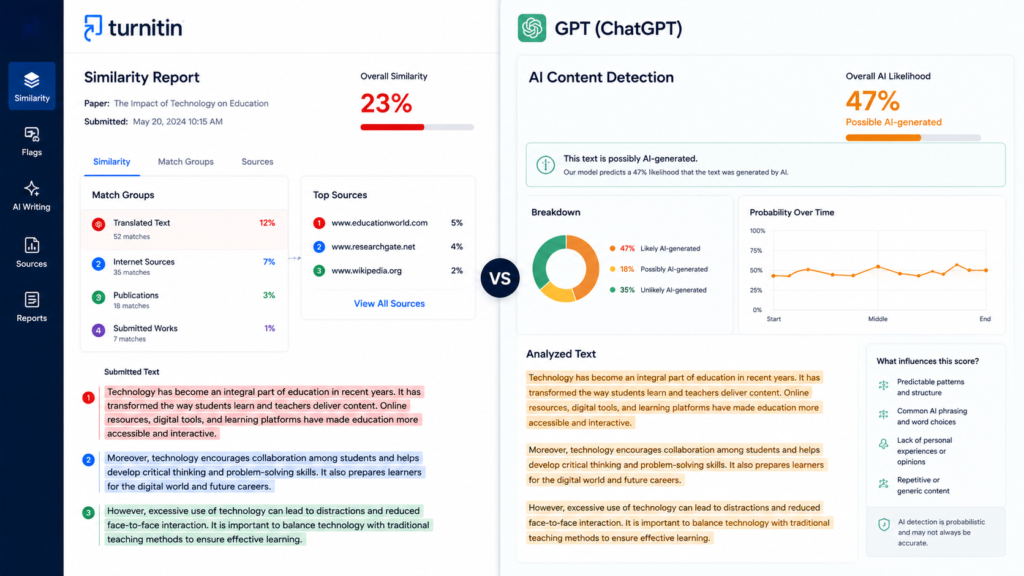
So does running the text through the translation make it “invisible”? Sometimes this lowers the AI score a bit, maybe changing it from blatantly obvious to “well, that’s suspicious”. However, it rarely enters a truly safe zone. In addition, professors and reviewers are increasingly noticing signs of typewriting—clumsy phrasing, bland vocabulary, overly perfect logic—even in translated work.
Bottom line: translating ChatGPT’s output does not translate into its own words. It’s just a slightly more blurred copy of the same original problem. If your teacher, school or university cares about real writing and honest work, using this method is still risky – and even if Turnitin is partially lost, getting caught using AI text (in any language) is still against the rules. Translation usually confuses the evidence, but usually does not erase it.
The Future of Turnitin and Multilingual Detection
Turnitin’s ability to spot translated text is becoming increasingly prominent, and this trend will only continue to grow. Technology is advancing rapidly, and soon computers will be able to track the meaning and structure of text, regardless of the language in which it began. It is no longer just a matter of combining words or phrases; these new tools are designed to recognize patterns, ways of arranging ideas, and connecting themes—even if the words look completely different when you run them through Google Translate.
For example, you can turn a German article into an English essay and barely leave a single word out. But if your arguments, point order, and examples match, these new detectors can often still mark them as a match. Companies like Turnitin spend money to make sure their software can spot these tricks. The small loophole of “I’ll just run it in another language and back again” closes quickly.
Here’s the thing: spending hours translating, changing wording, and dodging software is a lot more work than just putting your ideas out there. The more time you spend trying to outsmart the system, the less time you have for your voice – and it shows. Real, honest paper, even if rough, is distinguished by the fact that software and translation hacks cannot be faked. After all, the surest way to beat any detector is to make sure it’s really yours right from the start. That real effort gets you further, not just a lower likeness score.