
In today’s academic world, questions about plagiarism and AI-generated content are everywhere—and for good reason. As technology advances, so does our approach to the originality and integrity of our work. If you’re frantically searching “Does Scribbr use Turnitin AI detection?” midnight before a huge deadline, trust me, you’re far from alone.
Let’s cut through the confusion and get down to what’s important. Scribbr and Turnitin have become household names when it comes to verifying the originality of documents. But how do they actually fit together? And what exactly are they checking for, plain old copy and paste plagiarism, or have you had a little help from ChatGPT or other AI writing tools?
Scribbr vs Turnitin: What’s the Connection?
First, here’s how the platforms stack up:
- Scribbr is best known for its user-friendly proofreading services, link generators, and most importantly, a robust plagiarism checker designed primarily for students.
- Turnitin is pretty much the gold standard for detecting institutional plagiarism. You’ve probably heard it mentioned by your professors or seen it integrated into your student portal.
But here’s where things get interesting: Scribbr actually uses Turnitin’s technology under the hood to check for plagiarism. So when you submit your document to Scribbr for scanning, it’s Turnitin’s powerful database that does most of the heavy lifting behind the scenes. What you get from Scribbr is a student-friendly interface with additional explanations and guidance.
Plagiarism detection vs AI writing detection – what’s the difference?
There’s a lot of talk these days about “AI detection,” especially with students experimenting with tools like ChatGPT. However, it is important not to lump everything into “plagiarism”.
– Plagiarism Detection: This involves finding parts of your work that are too similar to published sources, web content, student work, etc.
- AI Writing Detection: looks for signs that the text was created by an AI tool rather than written by a human – basically asking, “Did a robot write this essay?”
From 2026 there’s a race to perfect AI handwriting detection, but it’s far from foolproof. Tools are still being worked on to reliably determine whether something came from a human brain or from an algorithm.
So… Does Scribbr use Turnitin’s AI detection?
Here’s the bottom line if you’re worried about getting tagged:
- Scribbr uses Turnitin’s plagiarism database, not AI writing detection tools.
- When you proofread text with Scribbr, you’ll see how original your sources are, not whether AI helped you write them.
- Currently, Scribbr does not offer an official AI writing detection service that is included in standard plagiarism checks.
- Turnitin itself deploys separate tools to discover AI-generated content directly within its ecosystem – mainly for institutional customers (ie through schools or universities).
So if you’re using Scribbr, the first thing it checks for is classic copy-and-paste plagiarism, not whether that opening paragraph sounds suspiciously like a chatbot.
What should students do?
Honestly? Stay informed. Technology is constantly changing underfoot, and what is considered “safe” today may change tomorrow as universities respond to new tools and trends.
- Use platforms like Scribbr to clean up citations and double-check originality.
- Write authentically – nothing beats your own voice when it comes to standing out.
- If you are unsure about the tools used at your institution, please do not hesitate to ask your lecturers or academic support staff.
At the end of the day, all these tools are: tools. Responsible management of them is just another 2026. part of the student.
The Core Relationship: Scribbr’s Plagiarism Checker Partnership
Scribbr uses Turnitin for plagiarism checking, but there’s a twist. Although Scribbr has partnered with Turnitin (in fact since 2021) and uses the same powerful software that universities rely on, there is a crucial detail: the discovery side of AI is a completely different story.
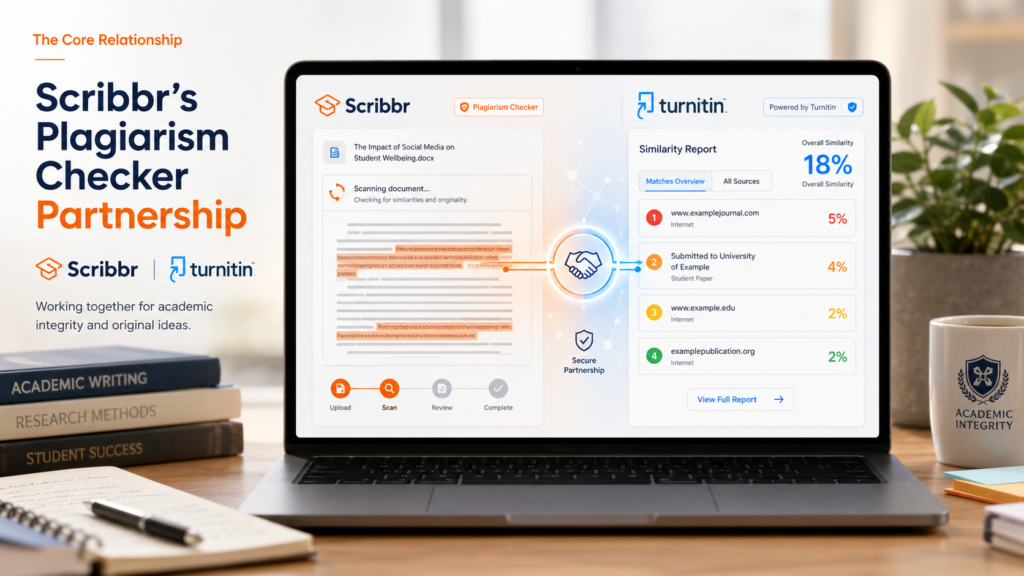
When you submit your paper to Scribbr’s plagiarism checker, it runs through Turnitin’s massive database. We’re talking billions of web pages, tons of published books and articles, and a nearly global repository of student essays. Basically, if it’s online somewhere or was submitted at school, there’s a chance that Turnitin can check it.
This is where Scribbr becomes particularly useful – you get a detailed report showing all text matches, along with a “similarity score”. This allows you to correct accidental plagiarism before your professor or university turns in your work. The best part? Checking out Scribbr does not save your work to Turnitin’s student work database. So, when you submit an official version later, your originality score won’t be messed up by the previous review.
The Crucial Distinction: Plagiarism Detection vs. AI Writing Detection
First, there is plagiarism detection (sometimes called text matching). Here, the tool checks your work against a huge database and searches for text that matches existing sources. You get a similarity score that tells you how much your document matches things that already exist. Here’s what you get when you use Scribbr’s plagiarism checker powered by Turnitin.
Then there’s AI writing detection which is a whole different animal. This technology tries to figure out if something was written by a human or if it was created by an AI like ChatGPT or GPT-4. It takes into account sentence styles, word patterns and various statistical clues to guess if it was written by a computer. The result? An “AI detection score” that is completely separate from the plagiarism check.
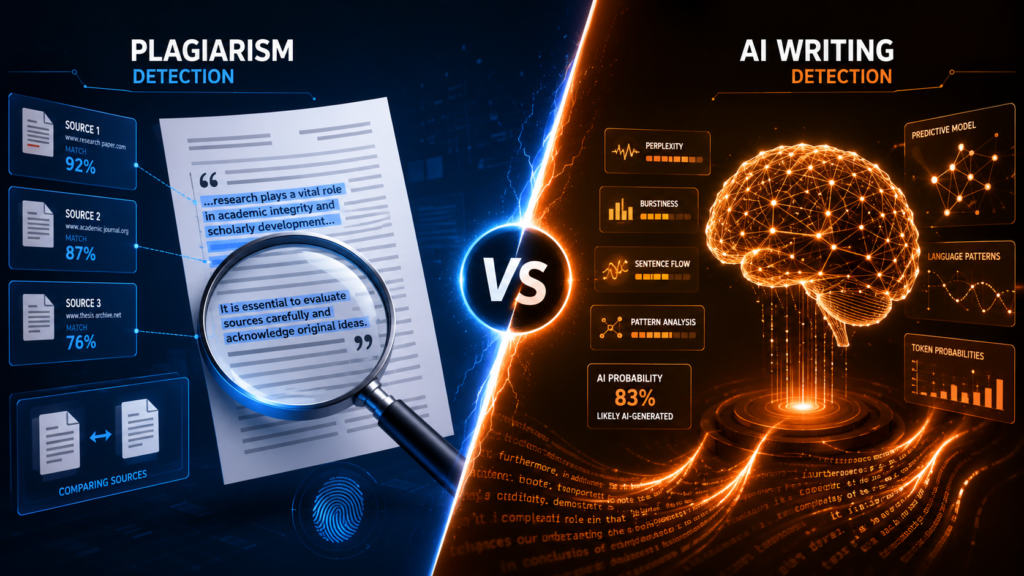
So here’s the bottom line: Scribbr DOES NOT include Turnitin’s AI writing detection as a plagiarism checking service for students. These are the different functions of the Turnitin toolbox. In fact, on the professor’s side (using Turnitin Feedback Studio), you can see both scores: one for plagiarism and one for possible AI authorship. When students use Scribbr, they only get access to the similarity (plagiarism) report, not the AI writing indicator. It’s basically about integrity checking when you’re drafting, rather than sniffing AI-generated content.
So, How Does Scribbr Handle AI Detection?
Many students I know are very concerned about being wrongly accused of using AI in their writing. Scribbr totally understands this – that’s why they took matters into their own hands and built their own free AI detector from scratch instead of just using Turnitin’s technology.
What makes the Scribbr tool stand out? For starters, it’s not a paid plagiarism checker, it’s a free, stand-alone detector designed specifically to capture content generated by famous AI models. Until 2026 it will be updated with everything from ChatGPT (both GPT-3.5 and GPT-4o) to Google Gemini, Microsoft Copilot, Claude, and Meta’s Llama. Basically, if there’s a popular AI chatbot, they follow it.
Another thing: Scribbr’s approach is quite unique in that they care deeply about accuracy and transparency. Their team ran various tests to see how their detector stacks up against others like Originality.ai, GPTZero, and Sapling. Not only do they publish comparison reports (so you don’t have to just take their word for it), but when you run the text through the tool, you get an actual probability score that tells you how likely each sentence is to be written by an AI.
Honestly, it’s reassuring to know there’s a no-nonsense, expert-based choice out there, especially if you’re worried your hard work could be called into question just because of an algorithm. And the fact that it’s free doesn’t hurt either!
The 2026 Academic Integrity Workflow: Using Scribbr as a Complete Suite
If you are in 2026 student, think of Scribbr as more than just another plagiarism checker, it’s essentially your ethical writing assistant to guide you through the chaos of academic assignments. A smart way to use it? Treat his tools like steps in a well-thought-out process:
First up: the AI check. Before you start worrying about citations or finalizing anything, you’ll want to run your draft through Scribbr’s free AI detector. If something you’ve written gets flagged as not-so-human-sounding (hey, it happens to the best of us), that’s your cue to add a little personality to it, by exchanging your words, thoughts, or style. It’s actually a tricky way to figure out how to turn any AI-generated raw fixes into something that really sounds like you.
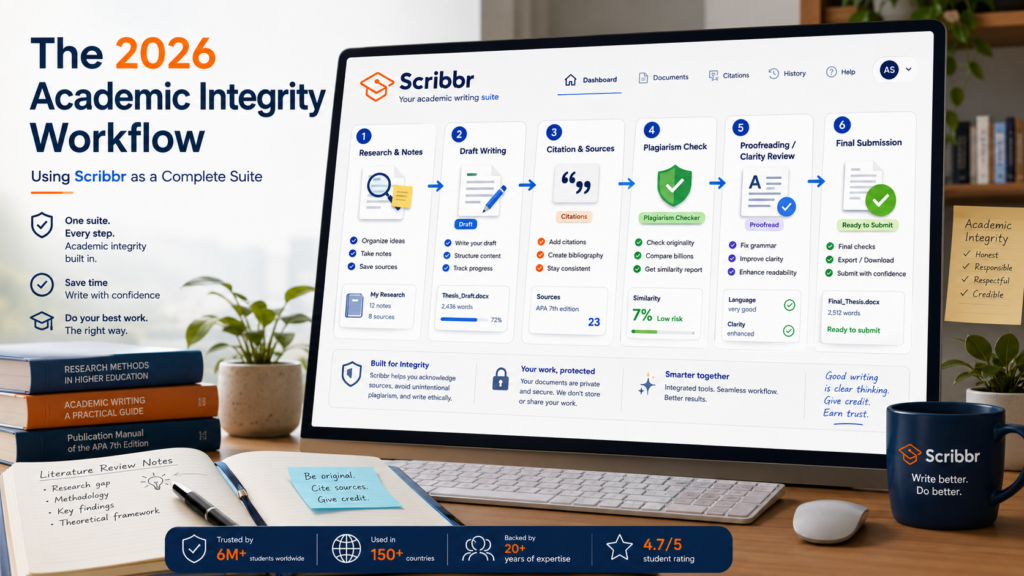
Then, once your writing feels like yours, it’s time to run a plagiarism and citation check. Scribbr uses Turnitin under the hood for this part, which means it will scan for accidental copying, slips, and even instances where you might be reusing a little too much of your old work. Trust me, self-plagiarism is a thing and it happens to more people than you think! The good news is that everything happens in one place, so you’re not jumping between dozens of tabs before the deadline.
Finally – and this is probably my favorite part – you have the option to have a real human expert review everything. No matter how many fancy tools there are, nothing beats real feedback from someone who knows what they’re doing. Scribbr editors will check your grammar, tone, flow…the whole nine yards. It’s that last layer of confidence before you hit submit, knowing that your document is original and actually reads like what you wrote (because it does).
The Future Trajectory: Specialization and Integration
If we look to the future, the difference between ordinary copying and being caught by AI reviewers is likely to become more pronounced. Big names like Turnitin already publish all-in-one reports that tell their school and university clients both “how much copied” and “how much AI costs.” On the other hand, sites like Scribbr, which are aimed more at students than institutions, are likely to develop tools to help people understand what constitutes appropriate use of sources and what crosses the line, especially when it comes to using AI in writing.
Scribbr’s main goal isn’t to mimic the rigorous, hidden tests that colleges use to catch cheaters. Instead, their goal is to teach students where the boundaries are when it comes to borrowing words and ideas, and how to use tools like AI in a smart, responsible way before submitting work for formal review. This way, students can get feedback, correct mistakes, and develop better habits without penalty. At the same time, firms focused on institutional clients will likely continue to tighten their checks, making things more difficult for those trying to cut corners. Thus, the divide is likely to increase, with one set of tools for learning and practice, the other for formal verification and enforcement.
Conclusion: Clarity for Confident, Ethical Writing
Scribbr does not use Turnitin’s AI detector. Instead, they strictly adhere to Turnitin’s plagiarism checks and have developed their own tool to detect AI-written text. That homemade version is open to everyone for free and they say it works separately from the plagiarism checker.
So if you’re using Scribbr in 2026, you’re actually looking at two sides of the coin: one part checks if you’ve copied from elsewhere (powered by Turnitin), and the other part tries to see if AI contributed to the writing of your paper (this part is their own technology). But what’s really important isn’t picking one tool and calling it out every day—they’re expecting students to actually reflect on their writing, use what those tools are telling them, and make sure everything is above board. Bottom line: Turnitin handles Scribbr’s plagiarism, but the AI detection is in-house, not Turnitin’s.