
It’s amazing to think how much academia has changed in the last couple of years, isn’t it? Generative AI burst onto the scene, and suddenly more than half of all college students (yes, 56% according to BestColleges 2024) admit to using it for assignments. Nor did professors and universities sit back and watch; they implemented some heavy-handed technical countermeasures, with Turnitin’s AI detector acting as a digital bouncer in the academic club.
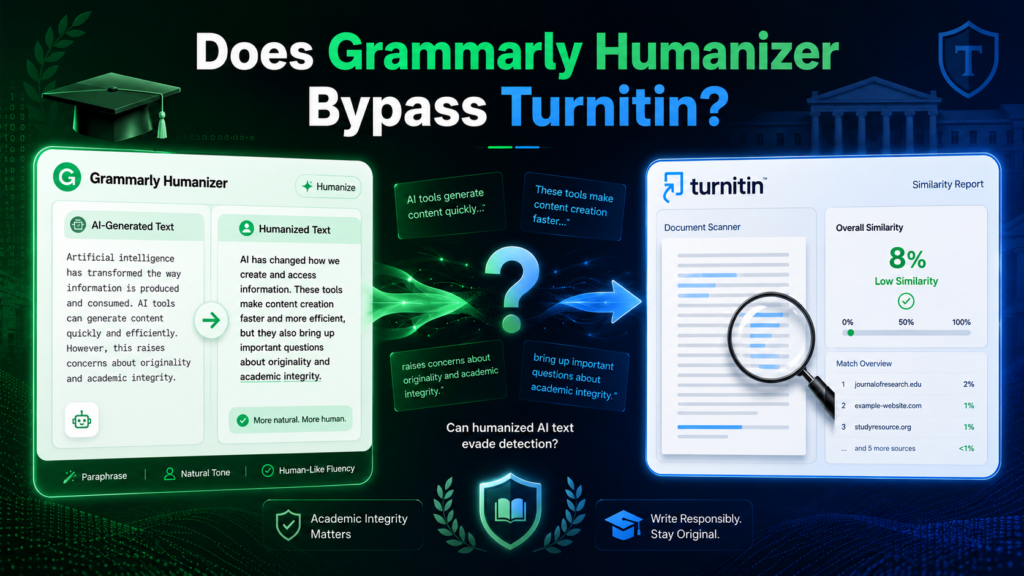
Enter Grammarly. Remember when it was your goal to spot the occasional typo or correct a misplaced comma? These days, it’s become practically a Swiss army knife for writers, with its generative AI features. And now, with the new Humanizer tool a feature some people are calling an “undetectable paraphraser” the Internet is absolutely abuzz with one pressing question: Can Grammarly Humanizer slip past Turnitin’s AI trap?
Here’s the bottom line: There is no black and white answer. The reality is a bit messy, with lots of technical twists and turns – and frankly, a bit of an ethical minefield too. If you’re wondering what’s really going on beneath all the marketing claims, let’s break it down:
How does Turnitin spot AI writing anyway?
First of all, Turnitin no longer just scans for copy and paste plagiarism. It uses fairly advanced algorithms to recognize patterns inherent in machine-generated text, such as unnaturally ordered sentence structures or suspiciously consistent vocabulary choices. Basically, if your essay reads like it was written by a computer that never gets tired or distracted, Turnitin notices.
So… Does Grammarly Humanizer do the trick?
This is where things get interesting. In theory, tools like Humanizer aim to shuffle your text enough that AI detectors can’t tell whether it’s written by a bot or a real person. But Turnitin’s technology is constantly evolving to include everything from predictive wording to soft sentence variety. Some students reported mixed results: you might hear it once or twice, and you might not. It’s a bit like sneaking snacks into the movies – sometimes it works, but don’t be surprised if you get caught.
The Bigger Picture: Implications and Questions
Let’s not make light of the elephant in the room: even if you manage to slip past the detector today, is it really a long-term win? Universities are constantly reviewing their anti-cheating policies and constantly updating their tactics. What if you get caught? It’s not just failure to complete that assignment that’s serious trouble, but potential disciplinary action (or worse, depending on the school).
Look, there’s no shame in wanting your writing to sound concise — or even lending a helping hand with rough drafts — but relying on technical gimmicks to avoid accountability? This can get you into hot water faster than you can say “academic test.”
Understanding: Turnitin vs. AI Writing
To understand if bypassing is possible, we must first distinguish between Turnitin’s two core functionalities.
1. Turnitin Originality (Plagiarism Check)
This is an old system for checking copied content. What you write pulls through a huge bank of student papers, published research, and more from the Internet to see if anything overlaps too much. Simple things like correcting your grammar with Grammarly won’t do that, but copying someone else’s work.
2. Turnitin AI Detection (The Real Adversary)
You know, one thing that people sometimes miss with Turnitin’s AI checker is that it doesn’t look for copy and paste like the old plagiarism filters used to. Instead, he’s trying to figure out if something “sounds” like the robot spit it out.
The point is, when people write, their brains are jumping. We fumble, throw out unfinished thoughts, throw in weird phrases, switch lines mid-sentence, or suddenly become extremely detailed. It’s natural. Looking at messages, work email letters or essays, there are ups and downs: a short jab here, a meandering story there. Turnitin calls that combination “bursting.”
On the other hand, most AI writing tends to follow safe paths. The word choice is like bricks and the rhythm is constant, almost too orderly. There aren’t many surprises in success, and the sentences seem like they all march in step. This is called “little confusion” – nothing too wild or unusual in the vocabulary or structure.
The people building Turnitin’s AI filter fed it all sorts of bots, from versions of ChatGPT to other text bots. When an essay is uploaded, the system checks how often the writing is “safe” versus where it deviates or deviates from the script, as humans tend to do. Based on that, it gives a chance score: “Hmm, 30 percent robot vibrations,” or “Wow, 95 percent likely it’s from a machine.”
It’s just a tool though. If someone is trying really hard to sound human—pausing here and there, using a weird turn of phrase, asking questions mid-sentence—sometimes the detector is fooled. But generally, humans are a bit messy and robots are a bit too perfect. Turnitin actually relies on this.
The Crucial Test: Can It Really Bypass Turnitin?
To answer the query “does grammarly humanizer bypass turnitin,” we must analyze the technical warfare between “text scrubbers” and AI detectors.
The Methodology of “Humanization”
You’ll find that those so-called “workarounds” like Grammarly’s reputation for calling itself the Grammarly Humanizer essentially try to trick AI detectors by changing how often certain words appear. Here’s what they actually do:
- Word Swapping: They swap words that usually appear with odd or less common synonyms. So instead of “use” you might see “recruit” or “use,” even if that sounds a little off in context.
- Jumbled Sentences: They change the subjects of the sentence, perhaps move the ending forward, or jumble the sentences. As a result, the writing sometimes sounds unnatural or awkward, like a sentence that needs to be read twice.
- Sprinkling in Errors: They purposely add typos or short choppy bits. This way it looks less “machine perfect” because real people make all kinds of small mistakes when typing fast.
- Randomizing words: They force the AI to choose less obvious words more often. It “heats up” the unpredictability by simulating the way humans can reach funny or even wrong words instead of average, robotic-sounding ones.
The Testing Results
These days, sites like Gold Penguin and blogs like Originality.ai have been running hands-on tests using Turnitin’s teacher dashboard to see how so-called “humanized” writing fares against AI detectors.
Earlier in 2024 people found that if they made the text more conversational or heavily altered, the Turnitin AI score often dropped from 100% to less than 20%. It made him seem almost believable. But those results were often just “false negatives” — the system was fooled, but not for long.
Everything changed after Turnitin later in 2024. has released a major update called Resistance Analysis. The tool no longer only looks for typical AI patterns, it now checks for parts of text that have been specifically rewritten or slightly tweaked to avoid AI verification. Tools that simply replace a large number of words, such as some “human” bots or plugins, may now trigger a new “AI paraphrased content” warning.
So the idea that you can always “beat” Turnitin is misleading. One day you may be able to bypass the filter with some trick, but the moment Turnitin tightens its network or updates how it detects changed text, the same file may be flagged even after it has already been submitted. There is no reliable way around this. If someone promises you guaranteed safety with a quick fix or scrub, take it with a big grain of salt.
The Future of Detection and Evasion
The question of whether the Grammarly Humanizer can slip past Turnitin is just another round in the back-and-forth between people trying to cheat and people creating defenses. And right now it’s more of a cat and mouse thing than a guaranteed win for both sides.
Let’s break it down. A watermark is coming if it isn’t already. Think of it as a hidden code embedded in the selection and placement of words, a fingerprint that persists even if you change the words or run the text through some “human tool” that modifies the grammar and vocabulary. If these characters are written during the generation phase, the text appears strange or unreadable when you try to remove them.

But Turnitin doesn’t just check whether the text “sounds” natural. They’re starting to look under the hood at how jobs are created, like metadata. For example, if you copy and paste an entire essay into a document in one go, or the timestamps don’t appear, that’s a red flag. Even if your sentences sound human, the path from the blank page to the finished essay can tell a different story.
Then there is student approval. Schools and universities may soon start collecting writing samples from supervised students and creating a sort of profile, tracking style, word choice, typical mistakes, all of that. It would be quite suspicious if someone who normally writes in plain, simple words starts writing essays that sound like they’ve eaten a thesaurus. Uncharacteristic vocabulary stands out a lot more than people think.
In short, tools that try to “humanize” AI text are more about putting on a mask than boiling out the traces that new detection tools are looking for. Changing words and correcting grammar works at a basic level, but it’s not magic. As proofreading gets smarter—looking at patterns, process, and personal writing style—tricks will become easier to spot. Fraud systems and capture systems will probably continue to run in circles, but the likelihood that simple humanization tools will be reliable decreases by the month.
Conclusion: A Tool for Deception, Not a Shield
Can Grammarly Humanizer Get Past Turnitin? Sometimes yes, but the ground is unstable. And frankly, it’s not just “can,” it’s “should.” Using apps that try to “make things sound more human” has alarm bells ringing for schools and teachers, especially since newer updates to Turnitin recognize when someone is trying to avoid routine checks. They are now catching people using humanization tools as a separate type of scam.
Grammarly was not designed to fool plagiarism detectors. Its purpose is to help you write more clearly, not to obscure who actually wrote something. If you plan to run the AI text through another tool to make it yours, you’re bypassing the actual learning and risking more problems. Instead of spending time trying not to get stuck, you can put just as much effort into actually writing and understanding the material.
At the end of the day, the best way to ensure that Turnitin doesn’t catch you isn’t fancy software. This means putting your ideas on the page, using your own words, and showing how you got there. It’s what teachers really want to see, and it will stay with you down the road.