
Bad grades, lost trust, damaged reputation, and legal trouble are the first things that come to mind when talking about plagiarism in schools. But teachers and professors say there are even more effects of plagiarism in education, based on what they’ve seen.
The writer feels less motivated, the learning community weakens, creative and critical thinking shrinks, morals get twisted, the human spirit fades, and even the immune system can suffer. These are some of the less obvious effects of plagiarism.
What are the consequences of plagiarism?
Copying work in college can lead to more than just bad grades. Cheating mainly harms the person who cheats. Here are some things that can happen when you use someone else’s writing.
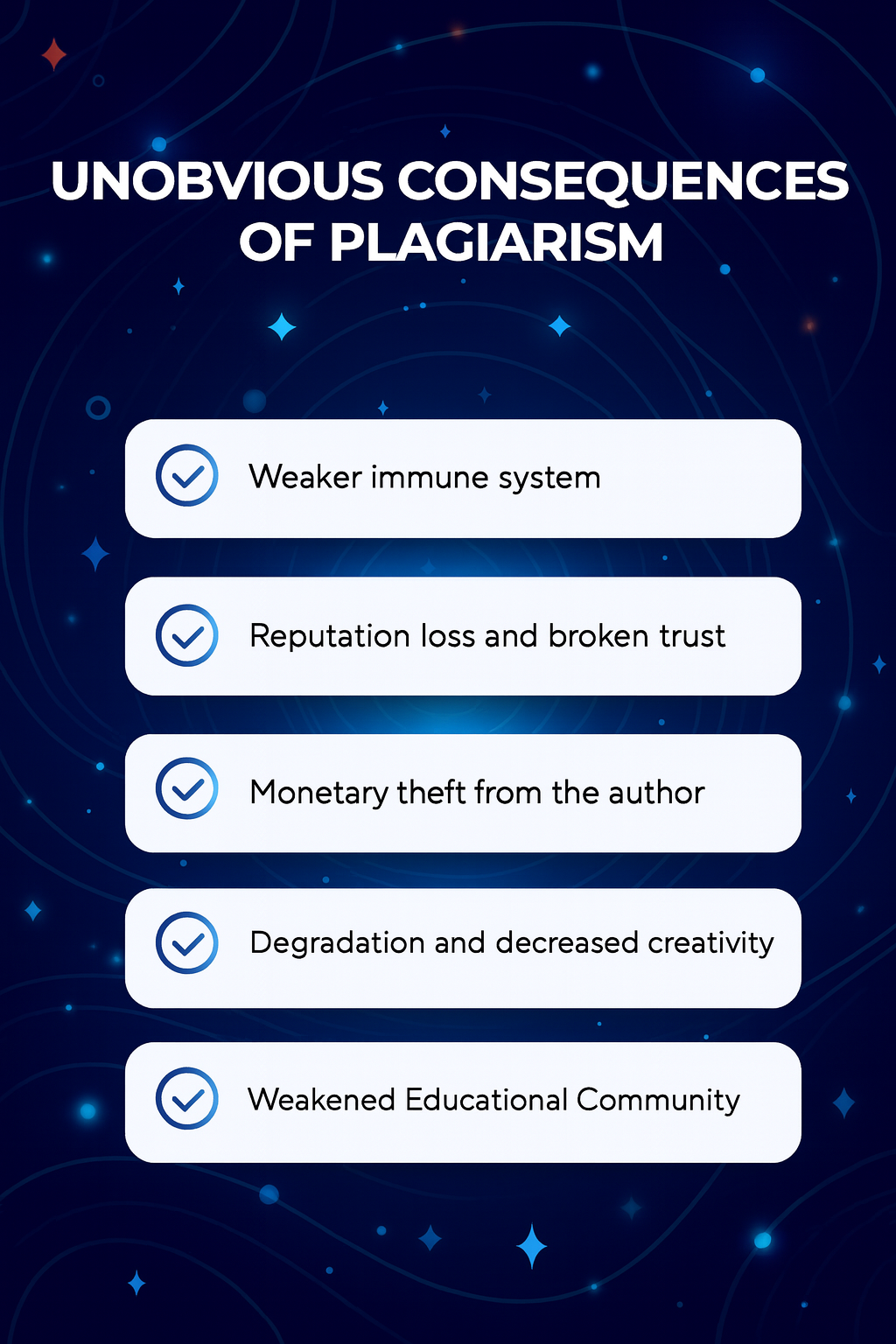
Weaker Immune System
David Leonhardt,
The person who started THGM professional writing service has also written two books about being more effective personally: “Climb Your Stairway to Heaven” and “The Get Happy Workbook.”
Once you write something, you can’t take it back.
You might make promises you can’t fulfill.
Your reflection will remind you of your actions.
Stress from guilt or fear of getting caught, or both, can weaken your immune system.
If you ever need a security clearance, these things might come back to haunt you, even if you’ve forgotten them.
Reputation Loss
David C. Berliner
David C. Berliner is a Regents’ Professor Emeritus in the field of Education at Arizona State University. He is also part of both the National and International Academies of Education.
Sometimes, people assume that those who plagiarize have some understanding of the content they copy.
Once, someone took a section from one of my published works and included it in a doctoral thesis at a Christian school. Beyond the many moral problems, there’s this idea that the person who stole my work has expertise in a specific area, which she actually doesn’t.
She pretends to be an authority in a field where she lacks in-depth understanding. True expertise is not the same as being able to repeat information that was taken from others.
Phil Turner,
A teacher and writer, Phil taught science and chemistry at two schools in Wigan and St Helens from 1975 to 2003. His site is bizzrepublic.com.
Copying others’ work harms your name. Your reputation matters most, and losing it is a big deal. It’s like money, the base of your success. People judge you by it, and only a solid reputation lets you make a living.
Camile Clarke,
A high school Geography teacher in Jamaica instructs students from grades 9 to 11. For the grade 11 students, part of their work involves completing projects that require them to include a bibliography with cited sources.
In my view, a less obvious outcome is that students might end up with a bad reputation among teachers. This is because the behavior of not properly citing sources can appear in various subjects. Teachers do sometimes discuss student work, and those who regularly copy without credit are often pointed out. We usually go easy on students who make this mistake unknowingly, as they’re still learning about proper citation. However, doing it repeatedly or across different subjects, even after being taught otherwise, contributes to this negative perception.
Monetary Theft From the Author
Chad Morris
Chad teaches English and has a strong background in writing. He has over 15 years of trading experience in financial markets, which he showcased in his book about growth investing. Besides, Chad deals with ETFs, Forex, annuities, mutual funds, ETNs, and real estate.
Plagiarism is essentially stealing. It goes beyond just being dishonest in academics. When a book is taken from its original author and sold as someone else’s work, it’s a type of financial theft. It robs the original creator so the plagiarizer can profit easily. While often seen as academic misconduct, plagiarism in sales is purely an economic crime.
Degradation
Ana Marković,
An English teacher, translator, PR specialist, and former journalist with a Master’s in Religious Studies, I’ve observed that in our interconnected world, the effects of plagiarism will eventually become clear. Initially, though, the most subtle impact is long-term, eroding morals and diminishing human spirit, wisdom, and potential. Drawing inspiration from others’ knowledge—reflecting the universal mind in individual souls—leads to divine progress. However, merely using existing knowledge as if it’s our own stunts growth and eventually halts progress.
Smitha Muran,
A passionate teacher and writer who sees the education system in a complex way.
Plagiarism’s overlooked but serious result is the loss of “ideas.” It doesn’t just affect originality; it stops us from chasing new ideas by limiting imagination and killing the drive to innovate. This leads to original thinkers feeling isolated and cheats feeling lazily satisfied. Over time, this attitude spreads, where striving for excellence is swapped for easy, repetitive work, and the idea of “innovation” falls into a cycle of sameness and mediocrity.
Nancy Meshkoff,
When you copy someone else’s work, you miss out on learning skills you might not realize are important. If you have to write about ancient Roman religion, you might think you won’t need that exact knowledge later. But you’ll miss out on learning how to research, deal with different or opposing ideas, come to a conclusion, and explain it clearly. These skills are useful in life. Often, you don’t notice what you’re learning while you’re learning it.
Asemine Lijazi Ahmed,
English professors often highlight how plagiarism impacts careers, studies, or academic journeys. Yet, I believe a major drawback is that individuals who plagiarize ultimately harm themselves. Crafting exceptional writing or research demands skills like selecting apt quotes, taking precise notes, organizing sources, interpreting data, and acknowledging others’ work. Those who resort to copying miss out on learning these skills, which complicates life for them. Thus, by plagiarizing, they end up causing more harm to themselves than to others.
Decreased Creativity
Viktoria Hristova,
An English teacher, translator, and editor with CELTA qualifications.
Plagiarism can hurt authors. It varies by work type, but if someone invests effort into creating something and it gets copied, they might feel demoralized. For talented creators, choosing to stop because of this would be a big loss for everyone.
I see plagiarism as stifling creativity. Those who copy aim for quick success, but we know true achievements aren’t easy. Writers who plagiarize won’t become great journalists. Singers who copy others will stay average. Success requires effort and innovation. Though there might be failures, trying gives a chance to make a real impact.
Melvina Brandau,
An Assistant Professor of Nursing and a nominee for an Outstanding Teaching Award.
Plagiarism’s biggest hidden drawback is how it harms the one who copies. By copying, a person steals someone else’s effort and misses the chance to tackle the challenge of making something original on their own.
Meredith Granger,
She has a Bachelor’s degree in English Language and Literature with Education and is certified as a teacher by the Ministry of Education.
The student struggles to fully engage with the subject because their mind doesn’t actively wrestle with the ideas or concepts. If this process were done correctly, it would foster independent and original thinking on the topic. As a result, it leads to a lack of enthusiasm and shows that the person is missing critical and creative thinking skills.
Anna Gratz Cockerille
Anna Gratz Cockerille works as an editor at Heinemann Publishing. She also contributes to many blogs and journals. Before, she taught kids from kindergarten to 8th grade in Australia, Honduras, and New Zealand. Now, she advises schools to help them meet their academic targets. You can find her work at twowritingteachers.org.
It’s really unfortunate that plagiarism happens because it suggests students don’t appreciate their own ideas. When students copy others’ work, they miss out on the chance to learn how to express, explore, and support their own thoughts.
Weakened Educational Community
Rosemary Edmonds,
Plagiarism shrinks the space for academic discussion and ideas. When people copy others, they miss the chance to share their own thoughts on subjects. Their unique insights and understanding don’t get expressed. As a result, their input in academic conversations disappears. These discussions help people challenge and grow their thinking by reacting to others’ ideas. But if the debate sticks to a few copied viewpoints, this growth might not happen, and the whole learning community could suffer.
Broken Trust Between Teachers and Students
David Moadel
David Moadel teaches English Composition at a college in South Florida. He is also a writer and investor.
Plagiarism can cause a big problem: it breaks the trust between teachers and students. Teachers believe students will do their own work when they give an essay assignment. But when students copy, they break this trust. This makes teachers feel doubtful and suspicious. Once trust is broken, it’s hard to repair, and the feeling of betrayal can last a long time.
Consequences of plagiarism in business and life
Academic dishonesty, according to teachers, has a big impact on life and work. When people don’t have originality standards or an independent mindset, they end up copying others instead of creating their own ideas.
Plagiarism in business can be disastrous. Cheating in school affects life beyond college. You can’t build a trustworthy company on theft and lies. Legal issues also arise, as copying someone else’s work is intellectual theft, and the plagiarizer can face lawsuits.
The positive side is that schools teach the difference between plagiarism and drawing inspiration. Teachers help students improve writing and thinking skills, use citations correctly, and create original ideas and projects.
Tips for avoiding plagiarism
- Check out lots of sources and think about the info instead of just copying it.
- Be smart with AI tools: let them help you brainstorm, but don’t let them write for you.
- Always say where you got your info.
- Make your own mark: work with the info, don’t just say it again.
- Run your writing through a plagiarism checker before you hand it in.
Tools that check for plagiarism safeguard academic integrity and encourage original thought. Try PlagiarismCheck.org for free to find answers to today’s academic issues!
We’ve also created an AI checker named GPT to verify the authenticity of the texts you read and write. You can use this AI detector with our plagiarism checker on the website, as a Google Docs add-on, or as a browser extension.