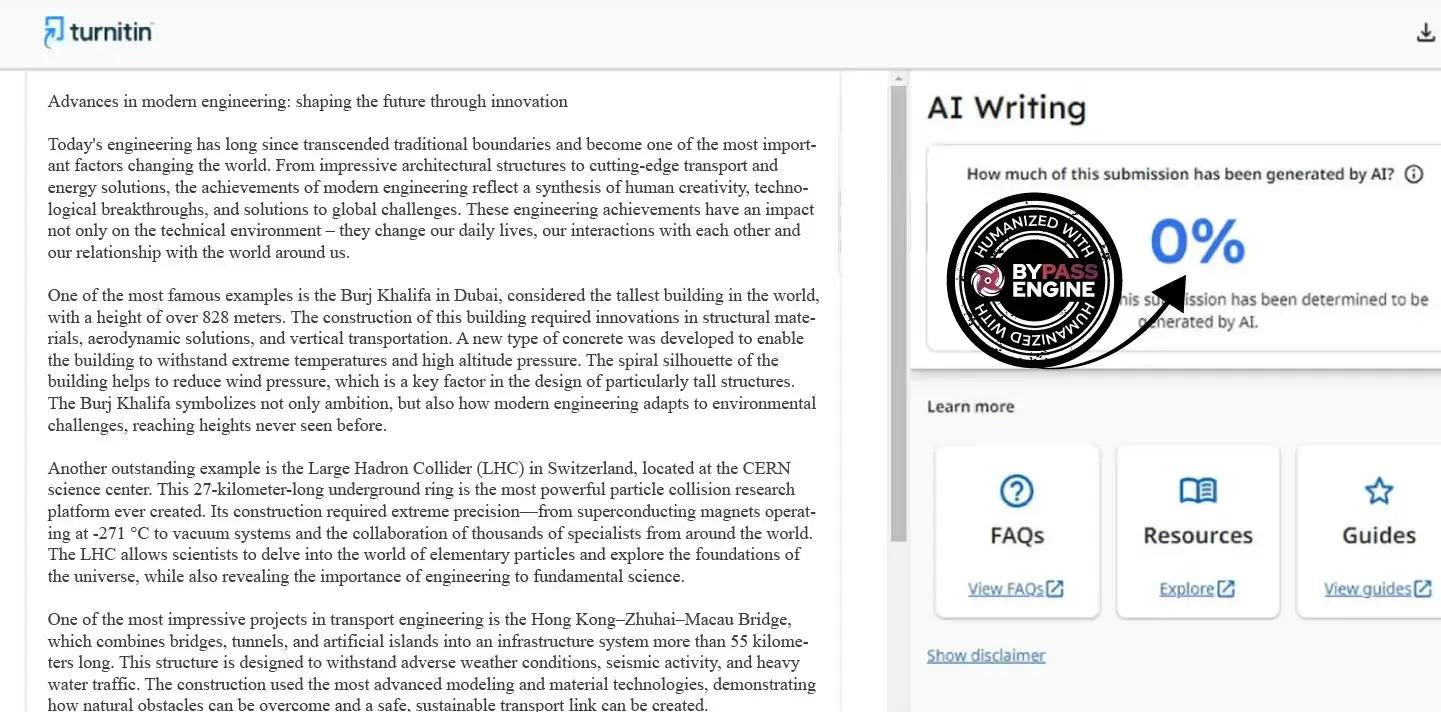
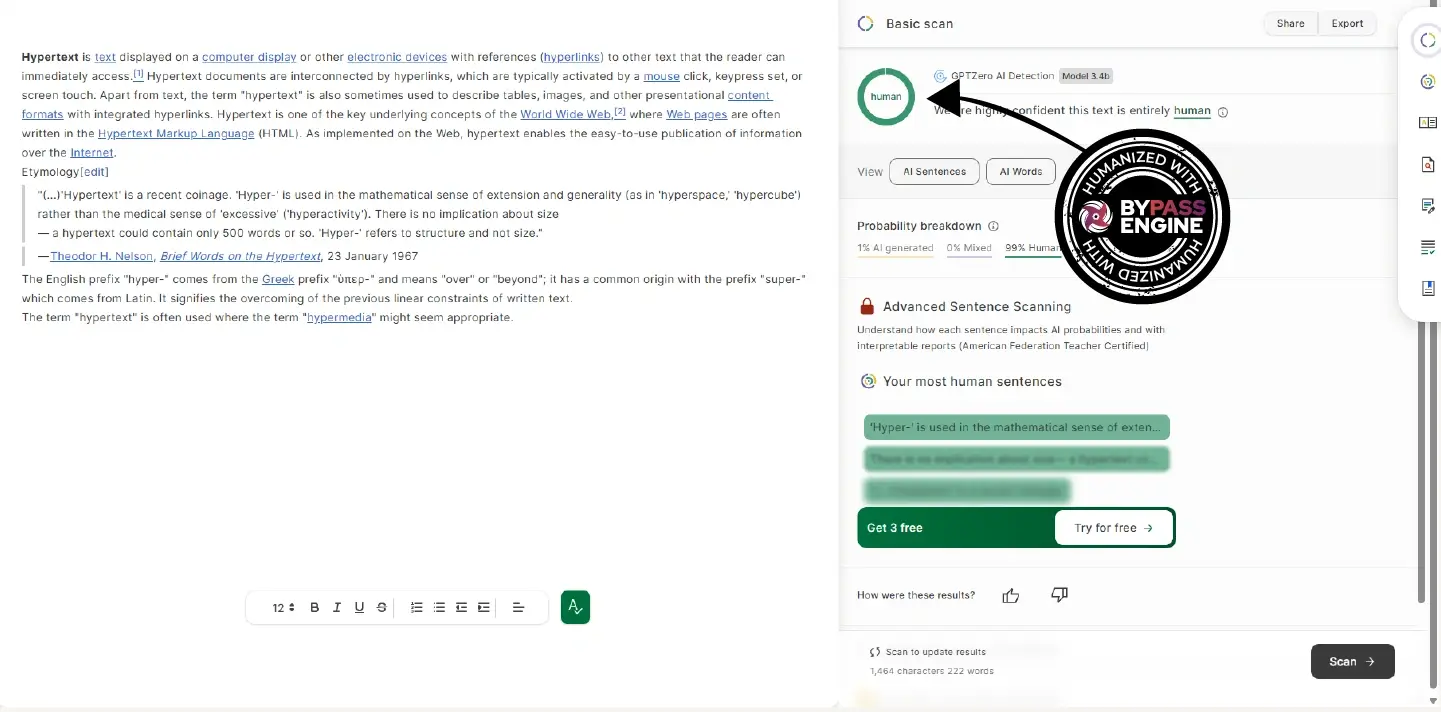
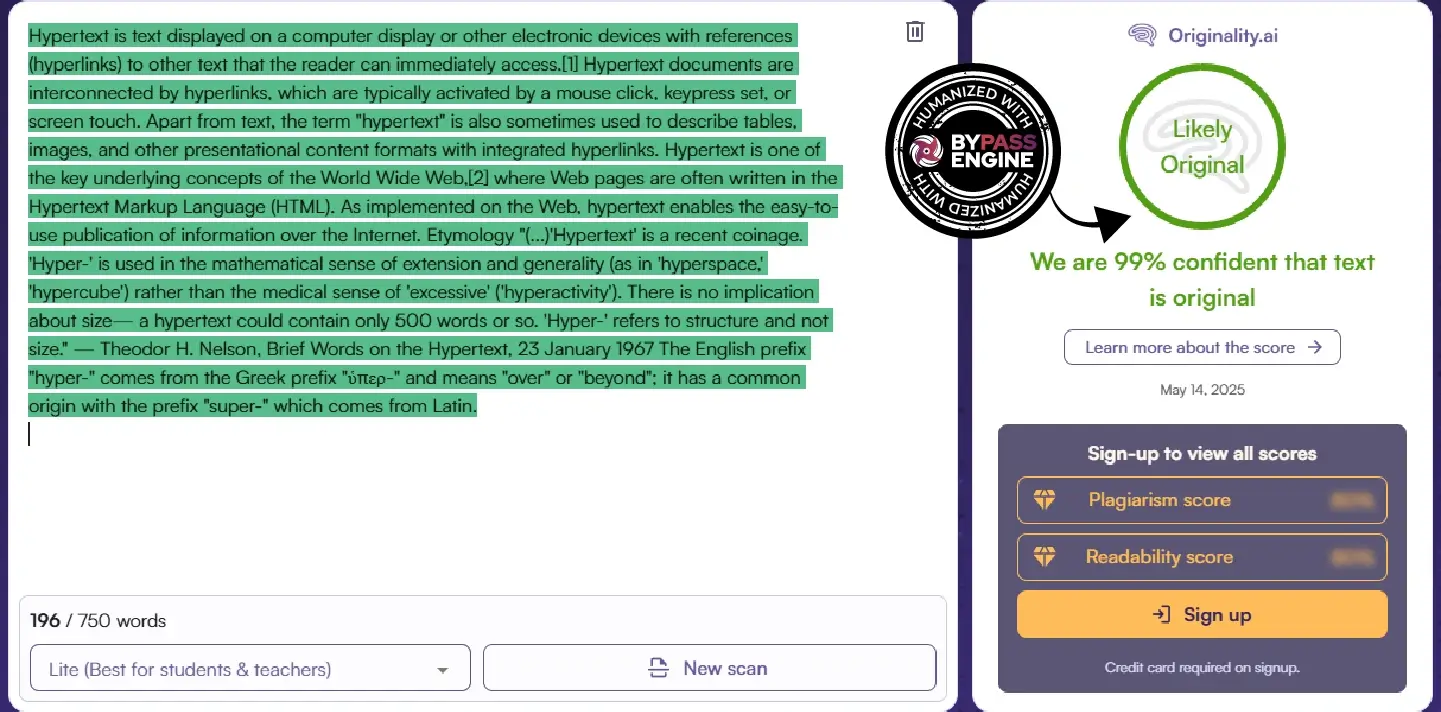
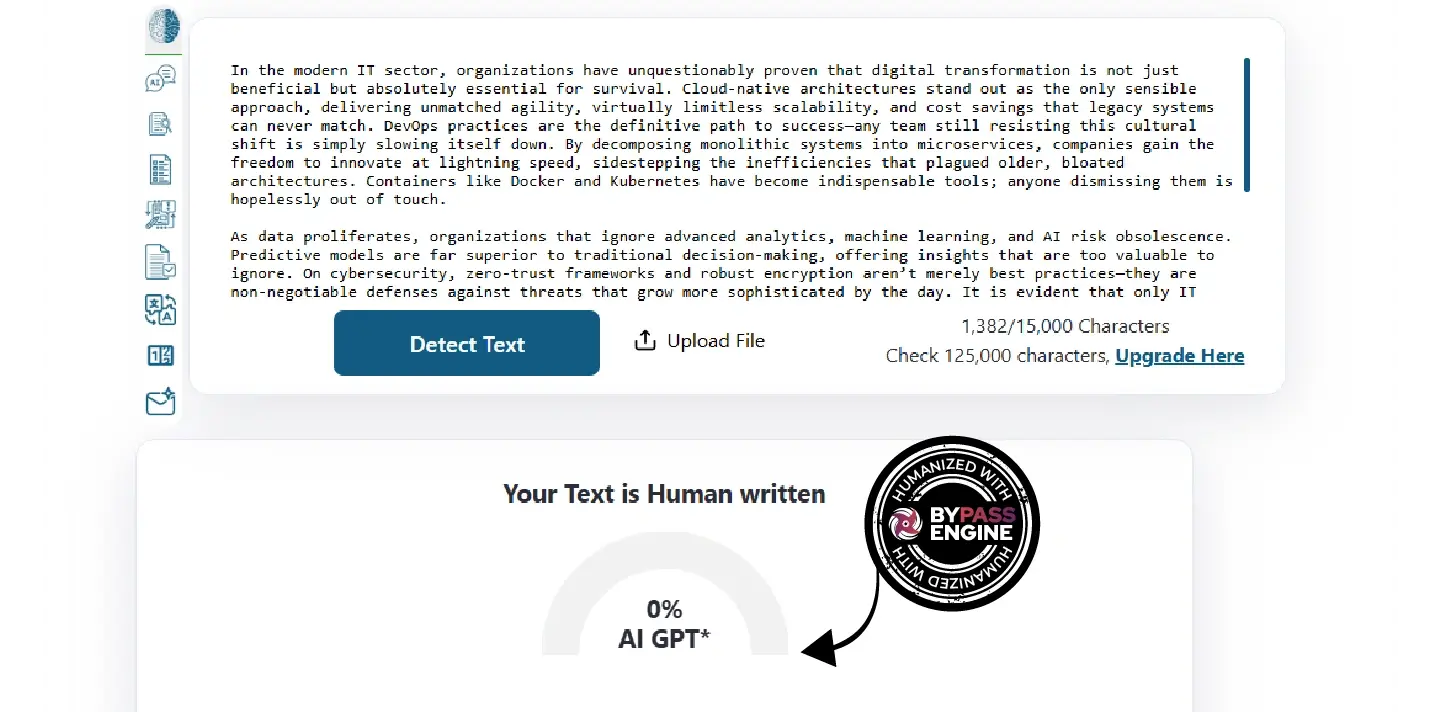
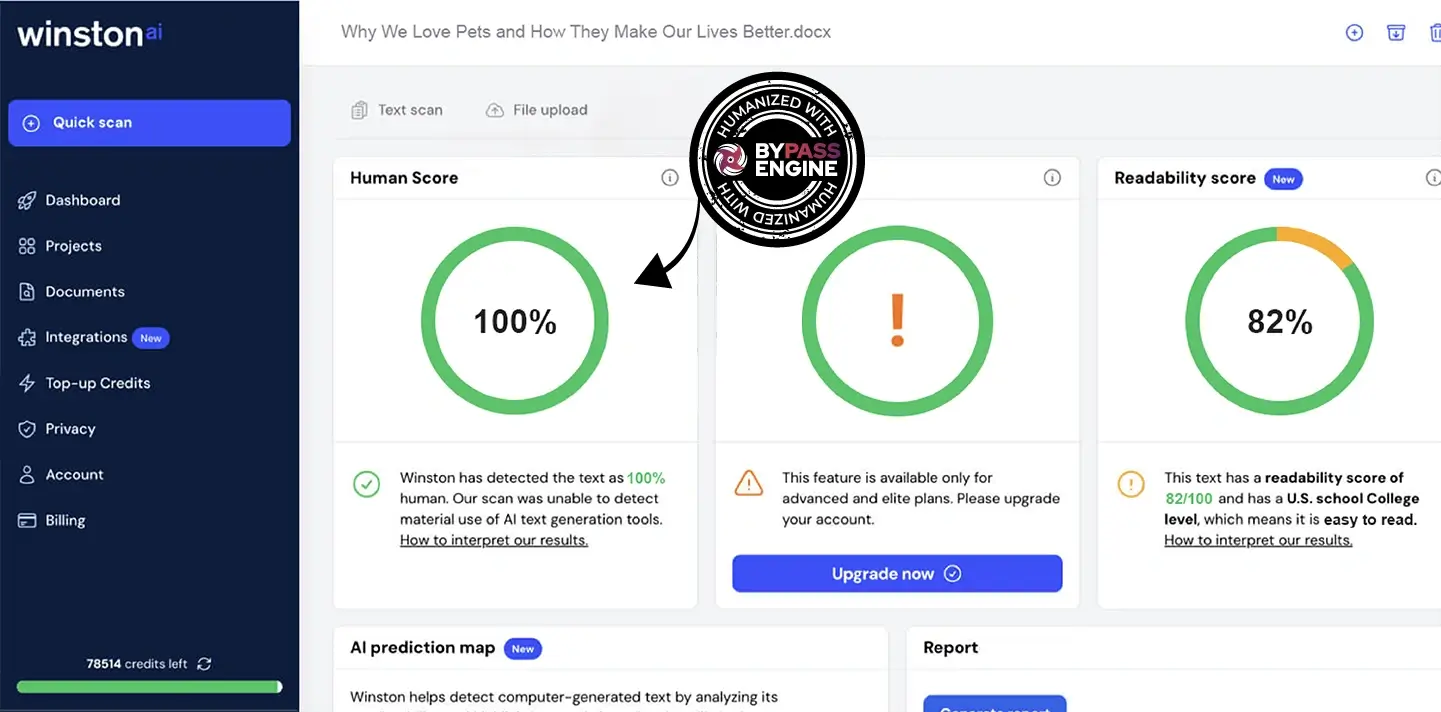
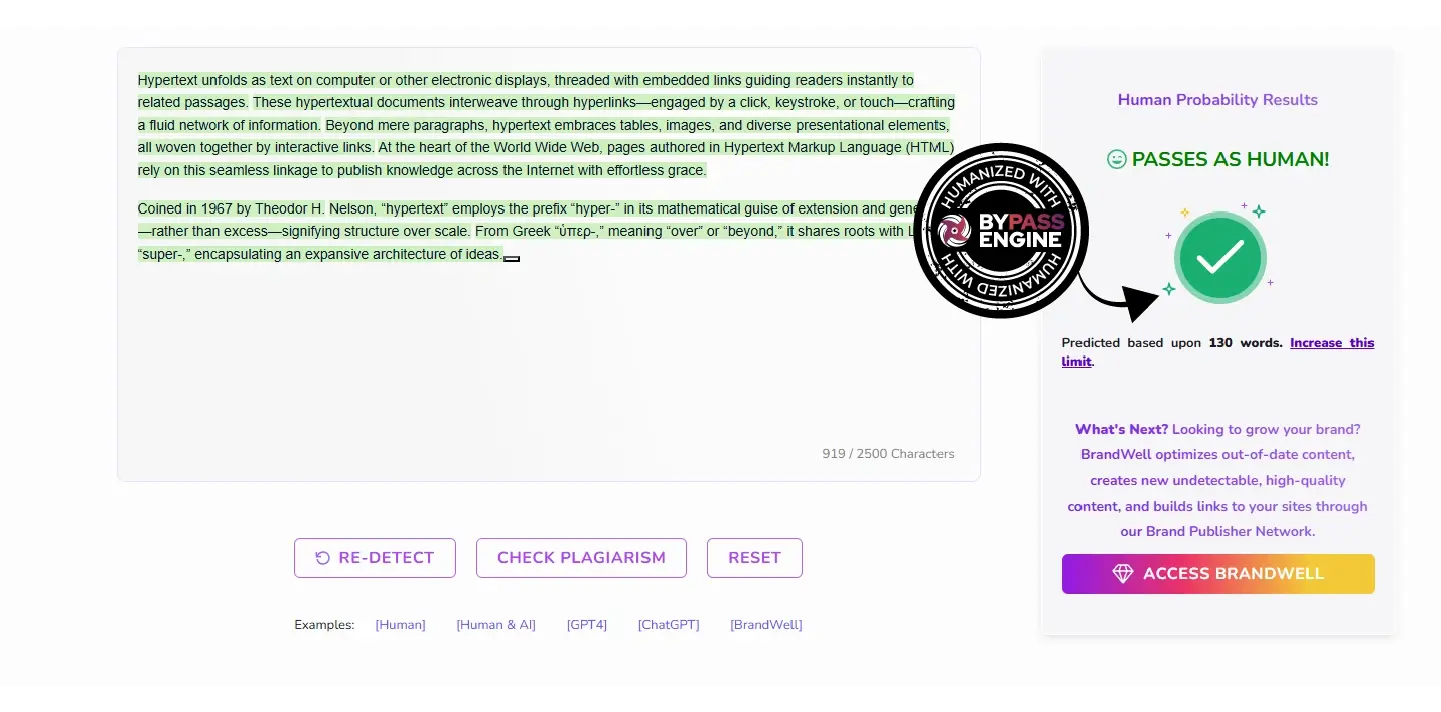
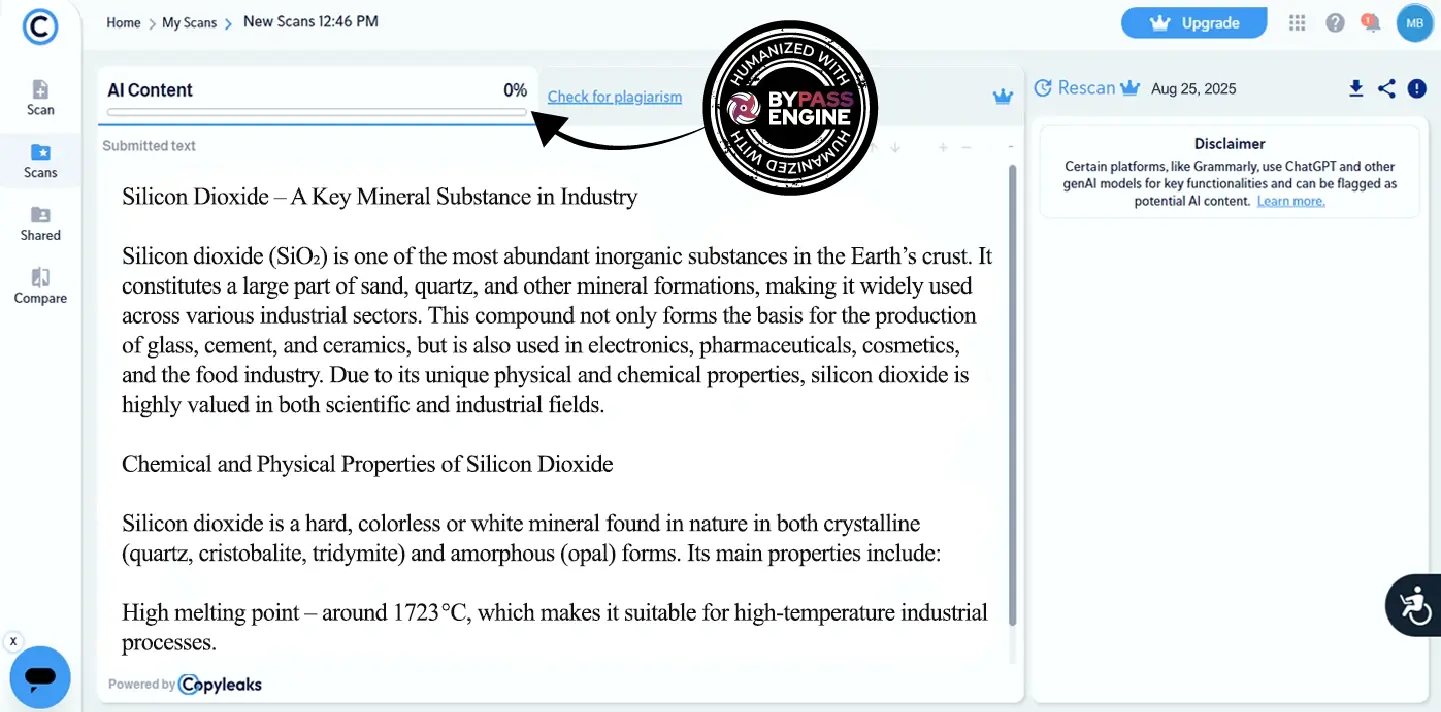
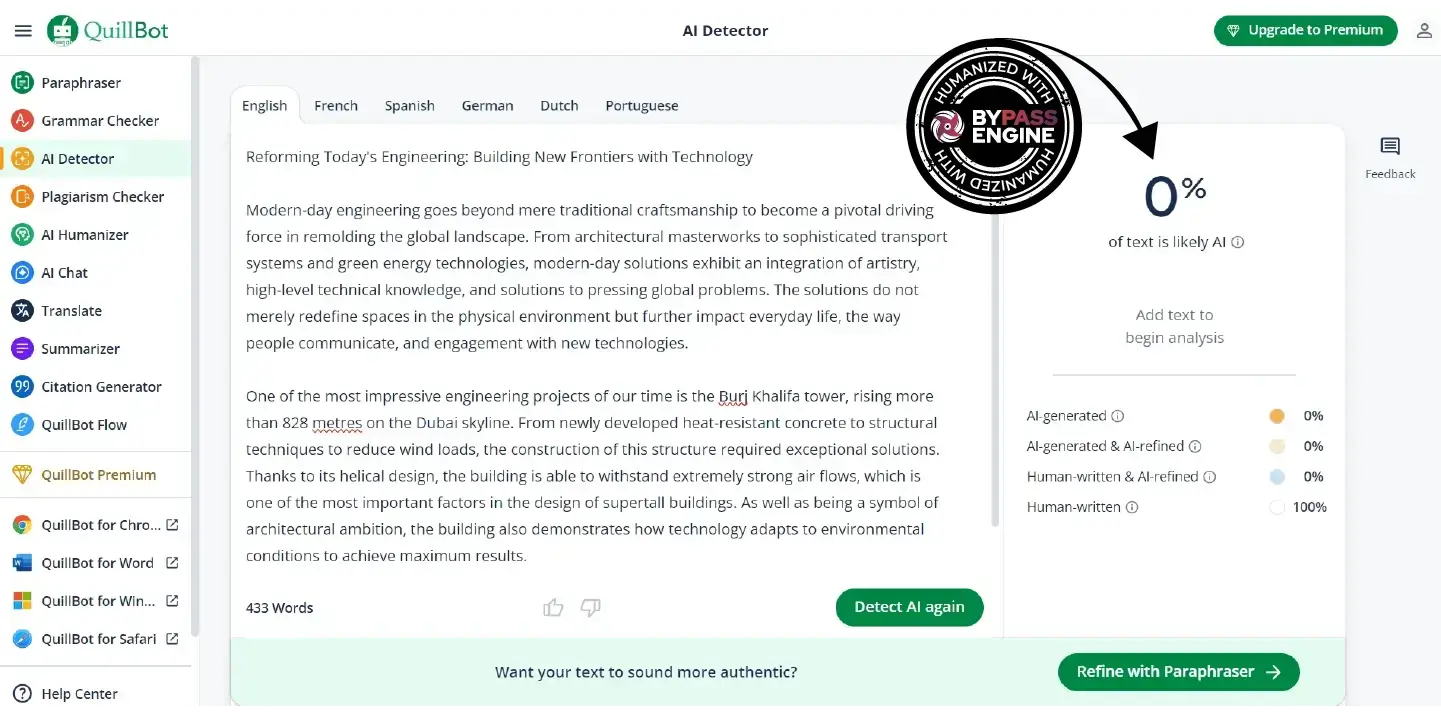
Our top-notch tool can detect AI-written text, like from ChatGPT and Bard. It helps make AI text seem more human. This way, AI checkers won’t spot it. So, relax and let our tool make your ChatGPT text undetectable.
Try Bypass Engine – it’s on us!
Scott Aronson shared an interesting method used by OpenAI. They insert tiny hints in the text. Imagine slipping a small clue into your sentences. This clue works as a hidden sign to show that OpenAI made the words. The main goal is to prove that a machine wrote the text. This is where our AI bypasser comes in. It makes ChatGPT’s content appear more human to avoid AI detectors.



Try Bypass Engine – it’s on us!
Our tool helps you find out if the writing is from a real person or if it was put together by a computer or artificial intelligence. It takes into account things like the words used, how sentences are put together, and how ideas move from one point to another. It’s a bit like how copied Turnitin spots work, but instead we’re checking for signs that point to an AI instead of a person.
by Veronica
I was skeptical at first, but after testing...
I was skeptical at first, but after testing it against Originality.ai and GPTZero, BypassEngine’s ChatGPT Bypass tool consistently passed. Now I use it for all my website.
by Ethan
As an SEO, I need content that ranks but...
As an SEO, I need content that ranks but isn’t AI detectable. This ChatGPT Bypass tool hits the mark. My clients have no idea. Worth every penny.
by John J.
I used to stress over my essays getting flagged...
I used to stress over my essays getting flagged as AI-written, even when I did most of the work myself. BypassEngine’s ChatGPT Bypass helped me avoid plagiarism in my drafts.
by Neil P.
My professor flagged my thesis draft...
My professor flagged my thesis draft as 60% AI-generated but t wasn’t. ChatGPT Bypass tool remade my paper and my professor never suspected a thing.
by Luke Phillips
Running 10 Shopify stores means creating...
Running 10 Shopify stores means creating a lot of product descriptions. AI speeds things up, but Google penalizes it. BypassEngine ChatGPT Bypass tool rephrases everything in a natural tone.
by Roger.
I’ve tried every bypasser out there...
I’ve tried every bypasser out there—StealthWriter, UndetectableAI & many others. Most just swap words awkwardly. ChatGPT Bypass rephrases my sentences like a real editor would!
for
students
Rewrite essays to bypass Turnitin and other detectors with ease.
for
marketers
Produce AI-assisted content that ranks without being flagged
for
researchers
Test AI detectors and generate untraceable academic summaries
for
copywriters
Transform AI drafts into content that feels written by you
for
developers
Transform AI drafts into content that feels written by you
for
journalists
Convert AI-generated notes into natural, publishable prose
for
authors
Polish AI-generated ideas into narrative-quality writing
for
AI research
Benchmark AI detectors using advanced bypass scenarios
95% of users content can be flagged with ai if ChatGPT Bypass is not used.
Secure Payment:
Bypass Engine AI bypasser has helped a lot of students and professionals to optimize their workflow, be productive and get the most out of their time while achieving their goals.
What matters now is getting past ChatGPT detection. As we head into 2024, creating unique content is tough without it being flagged as a copy. The big question is: can we make AI bypassers and humanizers work when OpenAI’s tech is so advanced? Definitely! Many tools, like Turnitin, Quetext, and Copyscape, can catch if your work is too close to someone else’s, even if you change a few words. But as these tools get better, so do bypass techniques. We’re here to help you get around ChatGPT text detection. We’ve made a smart AI tool that tweaks your writing just enough to keep the original meaning, tone, and style. Our ChatGPT content bypass algorithm is very effective, almost always getting it right. It’s great for anyone who wants to create new, original content without worrying about being mistakenly flagged for using AI or not citing sources.


AI tools now check if your writing sounds like you. They compare your old and new writing to find changes. They’re good at spotting if a computer wrote something by how words are used. We know how to bypass ChatGPT content checks. We help improve your writing so it still sounds like you, but better. We also ensure your work isn’t flagged by Turnitin, Copyleaks, GPT Zero, or other AI detection tools. You can trust our team and our tool to accurately bypass AI text detection from ChatGPT.

Bypass Engine is a multilingual ChatGPT Bypass utility that rephrases essays and sentences across languages.
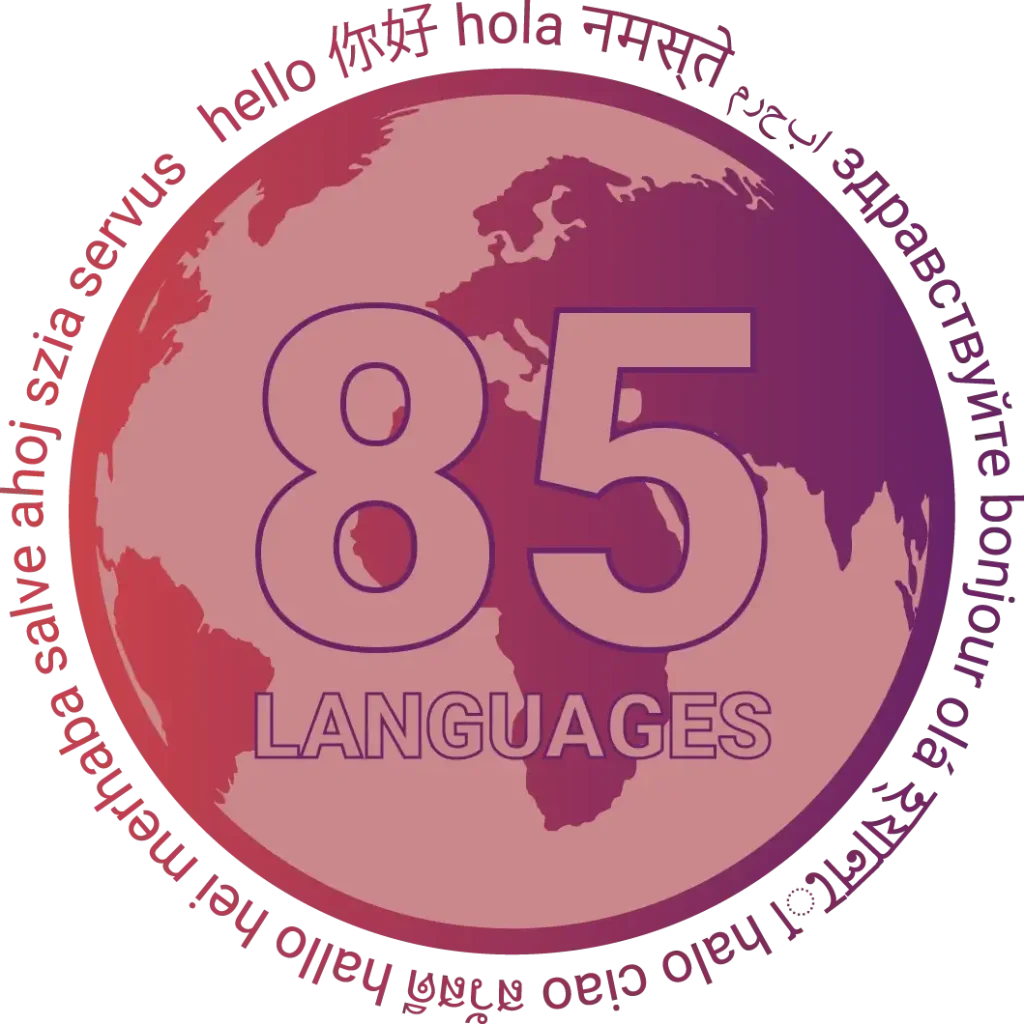
It supports 85 languages, including: Mongolian, Uzbek, Portuguese, Bashkir, Hindi, Kashmiri, Maithili, Romanian, Estonian, Welsh, Urdu, Oriya, Lithuanian, Hungarian, Kannada, Chinese, Pashto, Azerbaijani, Marwari, French, Belarusian, Slovene, Greek, English, Min Nan, Punjabi, Kyrgyz, Chhattisgarhi, Russian, Javanese, Vietnamese, Galician, Croatian, Dogri, Norwegian, Bengali, Armenian, Kazakh, Irish, Slovak, Finnish, Rajasthani, Catalan, Japanese, Serbian, Haryanvi, Awadhi, Santali, Danish, Faroese, Konkani, Bhojpuri, Brazilian Portuguese, German, Indonesian, Bashkir, Albanian, Montenegrin, Ukrainian, Maltese, Georgian, Malayalam, Macedonian, Arabic, Basque, Persian, Mandarin, Moldovan, Mandarin Chinese, Bosnian, Sinhala, Sindhi, Italian, Latvian, Sanskrit, Dutch, Korean, Czech, Malaysian and many more.
ChatGPT Bypass changes text to make it sound like a person wrote it. It tweaks sentences, tone, and words to help avoid AI spotting it as machine-made. This tool also makes the text easier to read and smooth to follow. It’s great for giving AI-made content a real, human touch.
To use ChatGPT Bypass, put in your text and ask for a rewrite that sounds human. The tool changes the text structure, removes patterns that seem like AI, and makes it flow better. It can help avoid detection, but it’s good to check it yourself, especially if you need to submit it for important reasons.
Yes, it can. ChatGPT Bypass handles many languages. It helps rephrase and improve non-English content, keeping the meaning but changing the expression to match the language. It works best in English but also does a good job with other main languages like Spanish, French, and German.
ChatGPT Bypass is good at rewriting text to hide AI patterns. It looks at tone, structure, and meaning to make the text sound more human. While it helps avoid detection, no method is perfect, as detection tools keep getting better.
Yes, ChatGPT Bypass can change flagged AI content by making it sound less robotic and more human. It is often used to make content pass AI checks. But, for the best results, it’s good to also do some light manual editing. This mix helps keep the writing natural.
Yes. ChatGPT Bypass not only avoids detection but also makes writing better. It fixes the flow of sentences, removes awkward phrases, and makes things clearer. It rewrites to make the text more engaging and friendly for readers. This helps lower the chance of being flagged by AI detection tools.
ChatGPT Bypass understands the context well. It changes the text, but keeps the main idea. It finds key points, changes sentence structure, and swaps in synonyms that fit the original tone and intent. This makes the content seem new and human-written, while keeping the original purpose and information.
Yes, it does. ChatGPT Bypass uses features to mimic how people talk. It adds emotions and mixes up sentences. This makes the content feel real and less like a machine wrote it. It’s great for making formal stuff sound more like a chat.

Using ChatGPT Bypass to rewrite your own work is not plagiarism. But if you use it to hide copied text from other sources without giving credit, that is plagiarism. The tool can help you rewrite, but you must use it ethically and give proper credit to avoid problems in school or work.
Yes, using these tools is usually legal and ethical for editing your writing. But, in schools or publishing, check the rules on AI help to stay clear and prevent breaking originality rules.

Yes, using ChatGPT Bypass is legal. It’s a tool to help you write, not a way to cheat. But, using it to trick others, like in schoolwork or contracts, could break rules or agreements. Always make sure you follow the law and act ethically.


In today's fast-paced tech world, it's key to avoid AI detection in ChatGPT content. That's why we're developing AI Rephraser, a tool that cleverly changes words and sentences while keeping the main idea intact. This makes the writing feel natural. Creating a tool to transform ChatGPT text into human-like text is tough. But with the right tool, we can seamlessly hide any edits, making it hard to tell if AI wrote it. Our special tool has no restrictions and is designed for this purpose, allowing you to use AI-generated content without detection concerns. You can make GPT sound human and tweak the writing as you wish.
Today, computers write a lot of what we read, but we want it to sound like it came from a real person. Tools like ChatGPT can make many articles fast. However, programs often catch these articles as being computer-made. This is important because it might make what we read feel fake and cause problems. Our solution is the ChatGPT bypasser tool. Think of it as a magic wand for your writing. It turns computer text into something that sounds like a person wrote it. This means using words that are clear, fun, and easy. It’s like having a friend who knows how to make your words shine. The tool doesn’t just swap words or mix up sentences to make AI writing seem human. It aims to capture the real way we talk. It wants computer-written stuff to not just sound human but feel human too. Interested? Sign up and see how we bypass AI detectors and transform ChatGPT content together.
In today’s digital age, artificial intelligence (AI) has woven itself into the fabric of our daily lives, influencing how we interact, communicate, and even think. Among the various AI technologies, ChatGPT stands out with its remarkable ability to generate human-like text. However, as its influence grows, so too does the curiosity about how one might “bypass” it. Why would anyone want to bypass AI, you ask? For some, it’s about enhancing creativity, while others seek greater privacy or a more authentic human touch. In this blog post, we will navigate the intricate pathways of AI bypassing, exploring why it’s a topic of interest and how one might approach it.
When people talk about “bypassing” AI like ChatGPT, it can sound like a clandestine operation. However, the truth is often more about creativity and adaptability than subversion. Take, for instance, a novelist striving to break free from predictive text suggestions to retain their unique voice. This isn’t about outsmarting AI but about preserving originality in an increasingly automated world. Bypassing, in this context, is akin to navigating a bustling city without relying on GPS; you might take a wrong turn here or there, but the journey enriches your understanding of the landscape.
In practice, bypassing AI can involve using varied vocabulary and sentence structures, much like a chef experimenting with different spices and cooking techniques. This diversity not only confounds AI algorithms, often designed to detect patterns, but also revitalizes communication by adding layers of nuance and unpredictability. Using humor, analogies, or even intentional grammatical quirks—similar to a jazz musician improvising mid-performance—can also keep interactions fresh and engaging, and distinctly human.
While the idea of bypassing AI can sound thrilling, it’s essential to consider the ethical implications. AI systems, like ChatGPT, are designed with safety protocols to prevent misuse and harmful outcomes. Attempting to bypass these measures could inadvertently lead to unethical practices or compromised security. Imagine AI as a diligent lifeguard at the digital pool; bypassing it without caution could lead to unintended dives into tumultuous waters.
Furthermore, there’s a responsibility to maintain a balance between innovation and regulation. As we explore creative ways to interact with AI, we must also respect the boundaries set to protect users from malicious uses. Bypassing AI should not be about exploiting loopholes but about enhancing how we coexist with technology. This aligns with the broader narrative of AI ethics, emphasizing transparency, accountability, and the pursuit of technologies that benefit all.
In conclusion, the journey of bypassing AI like ChatGPT isn’t about defeating technology but rather about augmenting our experience with it. It’s an invitation to engage with AI in ways that celebrate our human capacity for creativity, adaptability, and critical thinking. Just like a symphony incorporates diverse instruments to create harmony, our interactions with AI can blend structure and spontaneity, logic and emotion.
As we move forward, the conversation around AI bypassing will likely evolve, embracing new perspectives and challenges. It’s a dialogue that encourages us not only to question how AI serves us but also to reflect on how we wish to shape the future of this powerful tool. By doing so, we ensure that AI remains a partner in our digital narrative, enhancing rather than overshadowing our uniquely human voices.