
Medical schools are indeed monitoring the use of AI. They employ AI detection tools to identify content generated by ChatGPT and similar AI technologies.
This article will delve into the methods medical schools use to detect AI-produced writing and whether there are consequences for students. Additionally, we will explore how AI can be used ethically in medical education.
Let’s dive in!
Are Medical Schools Checking AI Use?
Sure, medical schools are watching closely for content made by AI, like in essays or classwork.
They use special tools, similar to plagiarism detectors, to spot text that might be from ChatGPT.
Not all schools are strict about AI yet, but many are creating rules to keep things honest and avoid shortcuts.
A big worry is that students might use AI to make up or stretch the truth about their experiences.
However, some schools use AI to quickly go through lots of applications to help manage the workload.
Do Medical Schools Use AI Detectors for Applications?
Many medical schools now use systems that spot AI-created work in applications. As tools like ChatGPT become more popular, admissions teams are turning to AI detection to ensure applicants’ authenticity. These systems search for patterns and styles that AI typically uses.
Admissions officers are trained to spot oddities in personal statements, using both AI tools and their own skills to check for genuineness. Some schools have clear rules about AI, while others are still adjusting to this new tech.
Using AI for small tweaks might be fine, but relying on it entirely can be risky. AI detectors keep improving, and applications that get flagged may face more checks.
But don’t worry! We’ve briefly explained how to avoid getting flagged by AI in one of the next sections. Stay with us.
Why Medical Schools Care So Much?
Medical schools worry a lot about AI in applications because it affects honesty, fairness, and how ready students are.
Admissions teams want candidates who can talk in a real way, showing they can think critically and understand themselves, which future doctors need.
Using AI-made content makes fairness a concern. If some applicants use AI and others don’t, it’s not a level field.
Too much AI use can also stop important learning skills like problem-solving and decision-making, which are key in medicine.
Medical schools follow strict educational and ethical rules.
They need to make sure students learn to think on their own, a critical skill for diagnosing and treating patients.
College Essay Written by AI: Pros and Cons / of Using ChatGPT to Craft Essays
AI tools like ChatGPT can help with medical school essays, improving grammar, structure, and clarity. However, personal stories are irreplaceable.
Pros:
- Enhanced Writing Quality – AI can assist in making sentences better, fixing grammar, and enhancing how easy it is to read.
- Accessibility – AI helps people who are learning English and those with disabilities.
- Efficiency – AI makes writing quicker, offering quick feedback and better organization.
Cons:
- Sounding Generic – Essays created by AI often miss the unique voice of the applicant, making them sound generic.
- Plagiarism Risks – Tools powered by AI learn from large collections of data, which might sometimes cause accidental copying.
- Over-Dependency on AI – Admissions officers look for unique voices, and essays crafted by AI can trigger alerts because systems might spot inconsistencies.
How Can Medical Students Bypass AI Detection?
The simplest way to avoid AI detection in medical school applications is by using an AI humanizer tool.
What is an AI humanizer tool and how does it work?
AI humanizer software, like Walter Writes AI, serves to transform machine-generated text into more human-like prose.
By refining sentence structure, improving clarity, and enhancing overall readability, such tools produce content that sounds natural. Additionally, they may enable AI-generated writing to avoid detection by plagiarism and authenticity-checking systems used in institutions like medical schools.
As an example, we will generate a personal statement using ChatGPT:
A Personal Experience That Ignited a Passion for Medicine
A pivotal moment led me to want to study medicine. It was unexpected and changed my life. A family member had a sudden health crisis, leaving us all in shock and unsure of what would happen. Watching the paramedics and doctors work so calmly and precisely in such a chaotic scene showed me the true power of medicine. It’s not just about saving lives; it’s also about giving people hope and comfort.
At the hospital, I saw how the medical team worked smoothly together, using their skills and knowledge to figure out and treat the problem. One doctor took time to explain things to us, turning complex medical jargon into simple language. This act of kindness made a huge impression on me. It taught me that medicine is more than just science; it’s about connecting with people, communicating, and building trust.
Now, let’s check its AI detection score using Walter AI Detector:
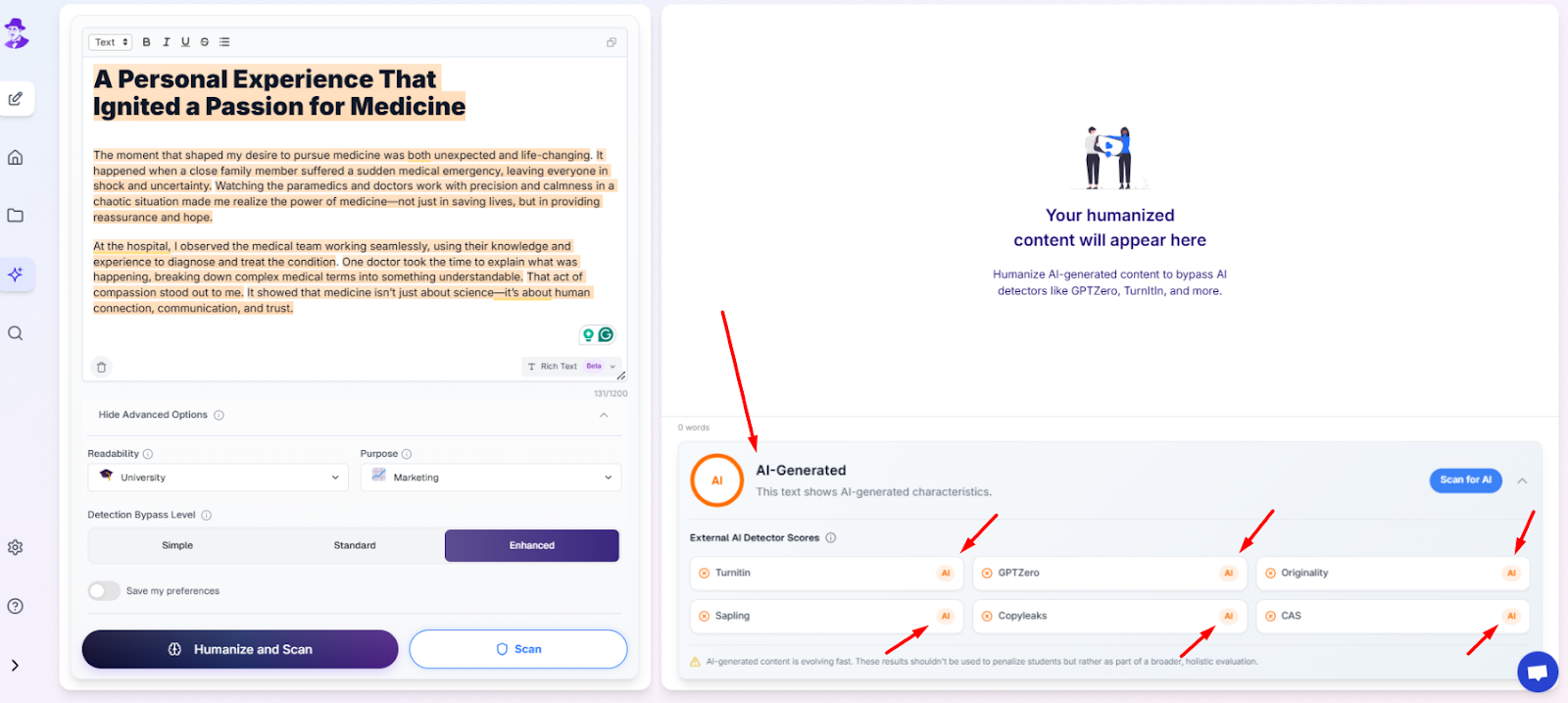
With a single tap on the “Humanize and Scan” button, the essay becomes more natural and ready to pass unnoticed by college admissions or scholarship committees.
You may think we’re partial to our tool because we showed just one success. Why not test it yourself and see if we’re mistaken?
The Future of Med School Applications
AI is reshaping how medical school applications are handled, streamlining things for admissions committees but also introducing new challenges for applicants.
With AI-powered tools, applications can be sorted faster, freeing up schools to focus more on interviews and comprehensive reviews. Still, the human touch in admissions remains irreplaceable by AI.
For students, AI can assist in brainstorming, organizing, and refining grammar. However, relying too heavily on it might lead to detection and questions about authenticity.
Medical schools value personal stories, critical thinking, and real-world experiences—elements AI cannot replicate.
As AI technology advances, institutions can either enhance their detection methods or clarify their policies.
AI might play a role in future applications, but genuine engagement will always matter. Schools seek future doctors, not just skilled essayists.
Applicants must submit personal statements that genuinely reflect their voices and experiences.
AI can aid the process, but it isn’t a shortcut to acceptance. Future applicants need to balance AI assistance with sharing their personal stories to make their applications stand out for the right reasons.
FAQs
Can med schools see if you used ChatGPT?
Medical schools now use AI tools to check if application essays have AI-generated elements. Even if you don’t use ChatGPT, content that gets flagged could lead to more scrutiny or questions about how you wrote your essay.
Do universities check for AI detection?
Fewer universities now rely on AI tools to spot AI-written essays and applications. Admissions teams appreciate honesty, and if an essay seems too robotic or overly polished, it might prompt a check for AI involvement.
Can you use AI to edit med school essays?
AI can refine grammar and structure, but relying too much may cost us our true voice. Admissions officers value personal stories, so let AI help, but don’t let it replace your unique narrative.
What happens if a college board detects AI?
If AI is found in a submission, the school might examine it more closely. This could lead to doubts about the essay’s authenticity. Depending on the school’s rules, consequences could include asking for a resubmission or rejecting the essay.