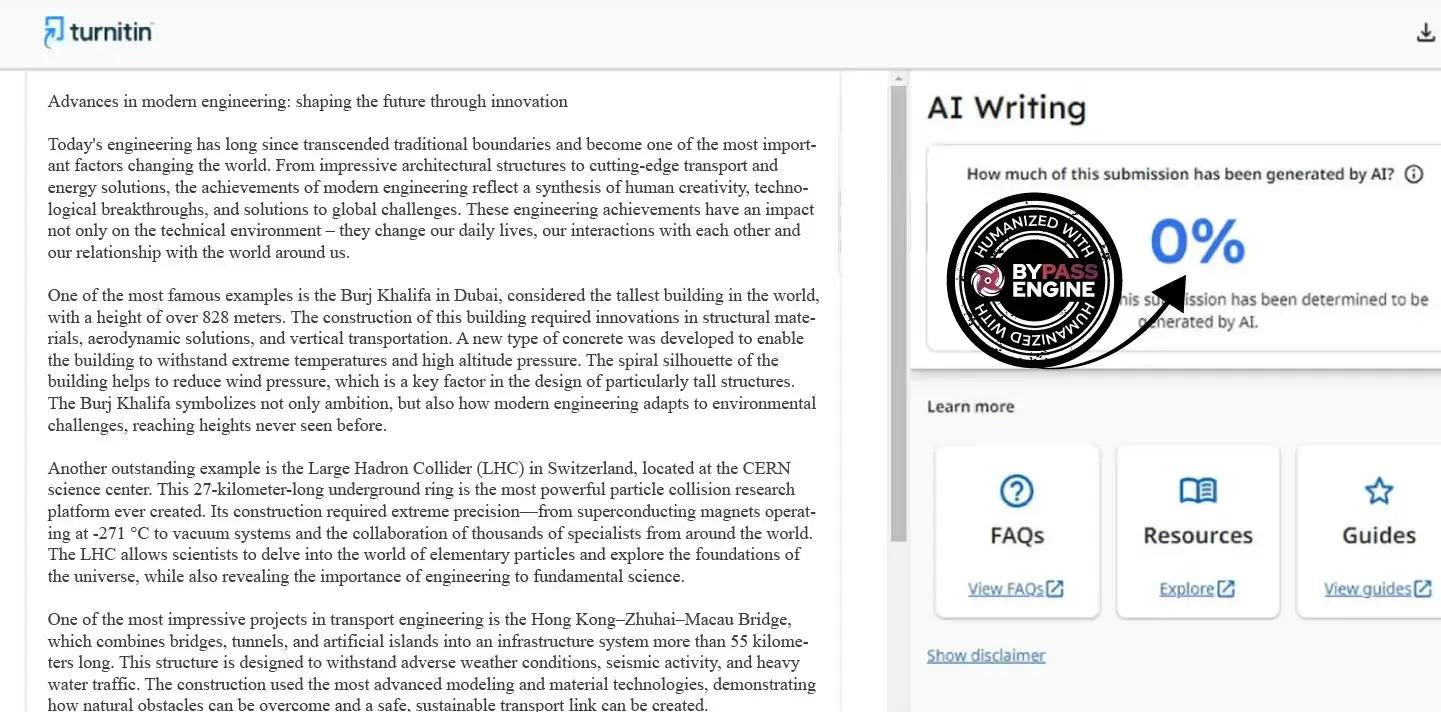
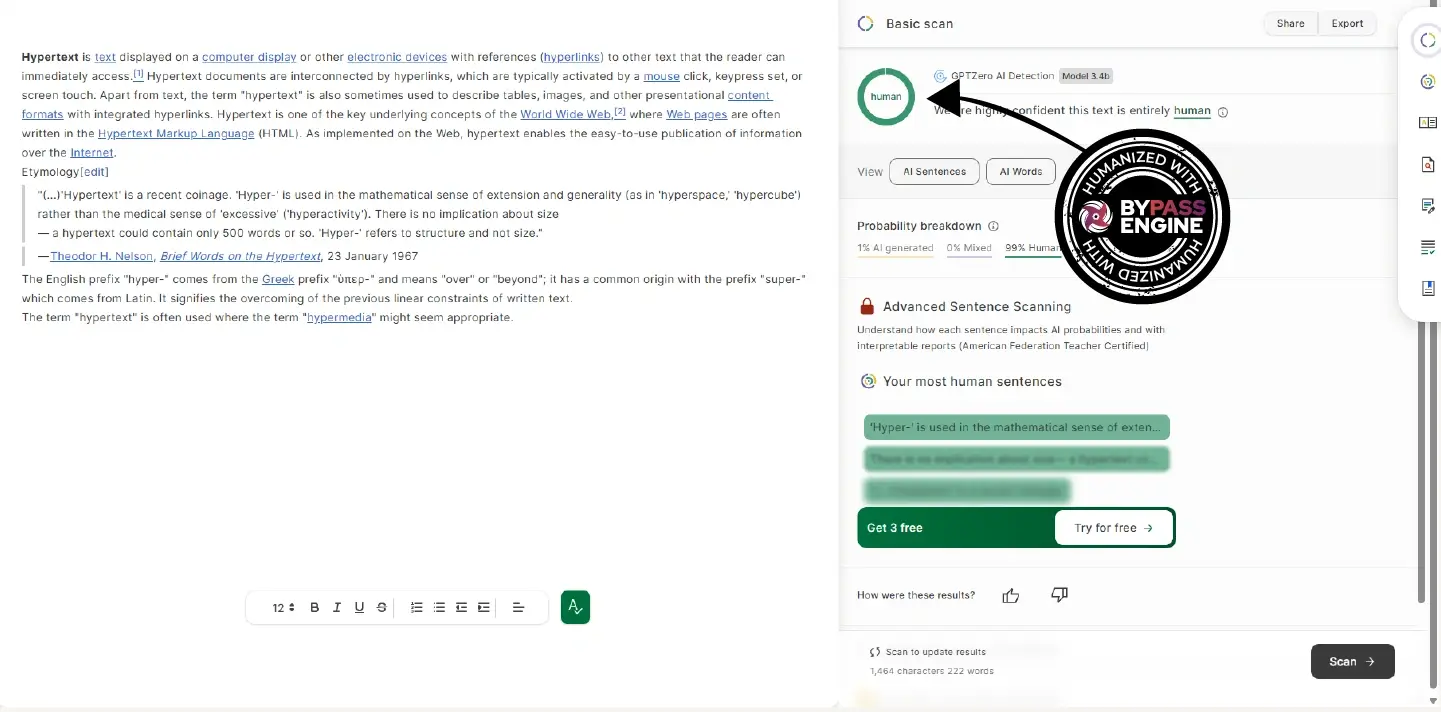
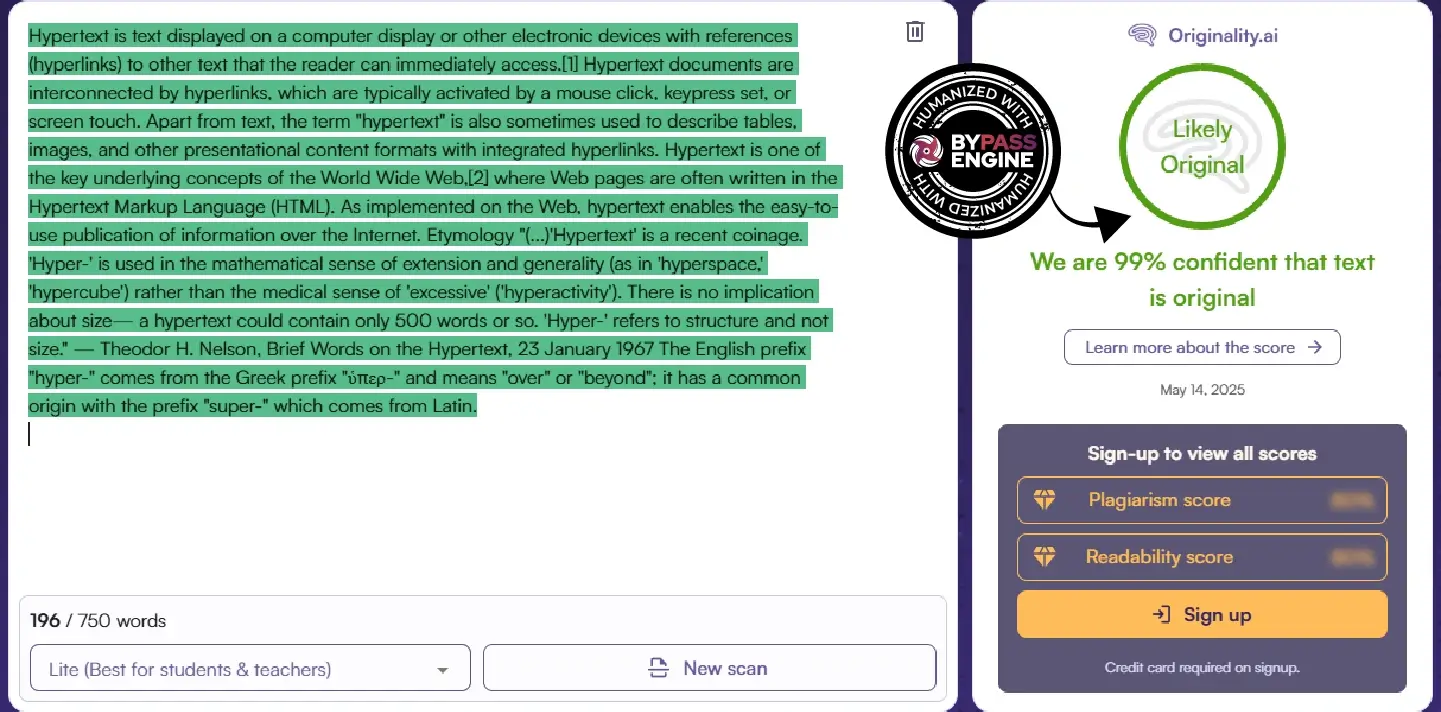
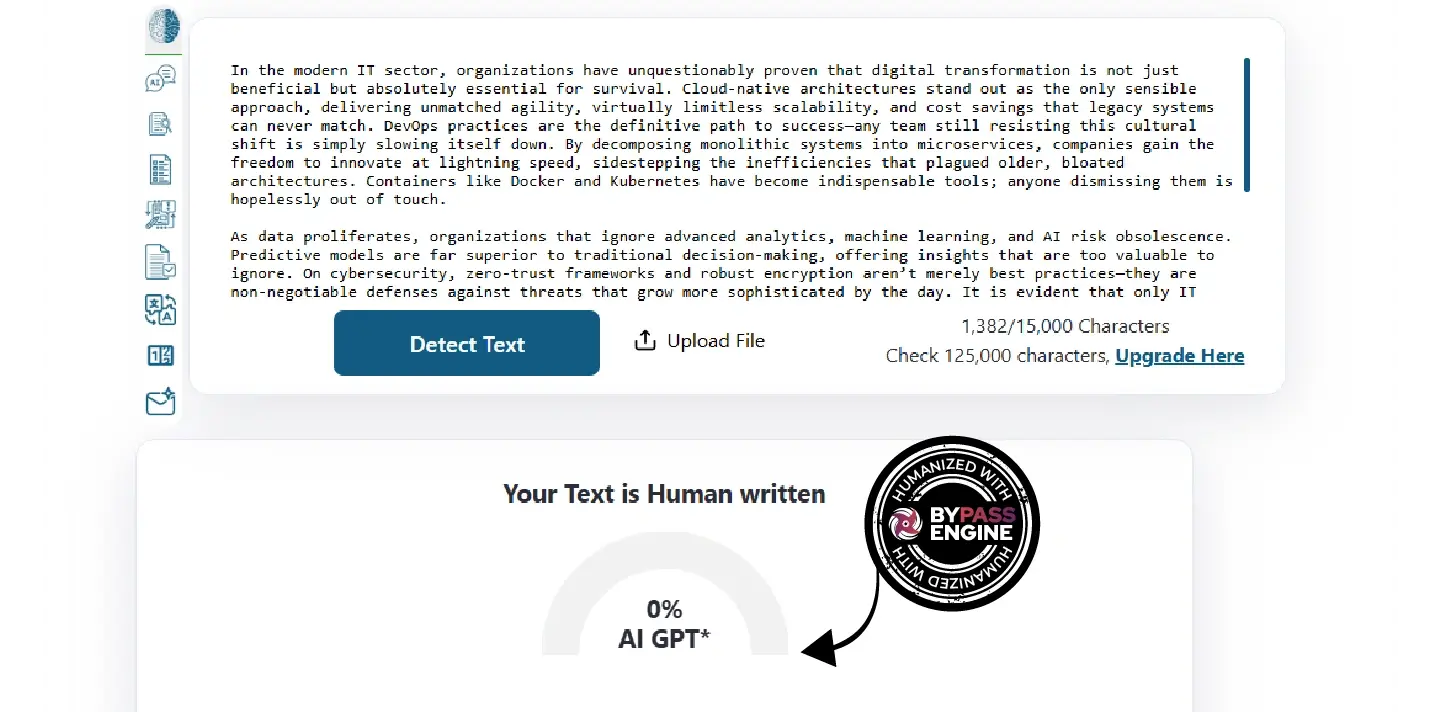
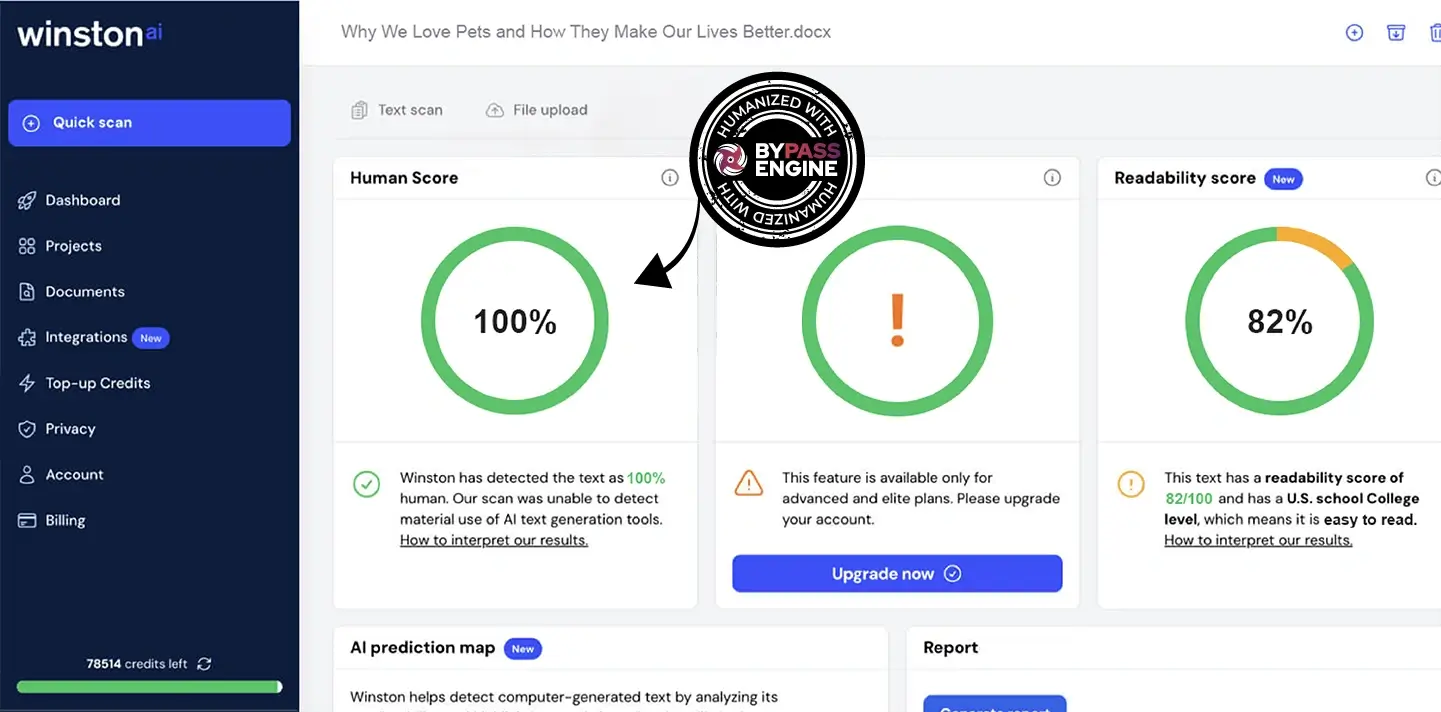
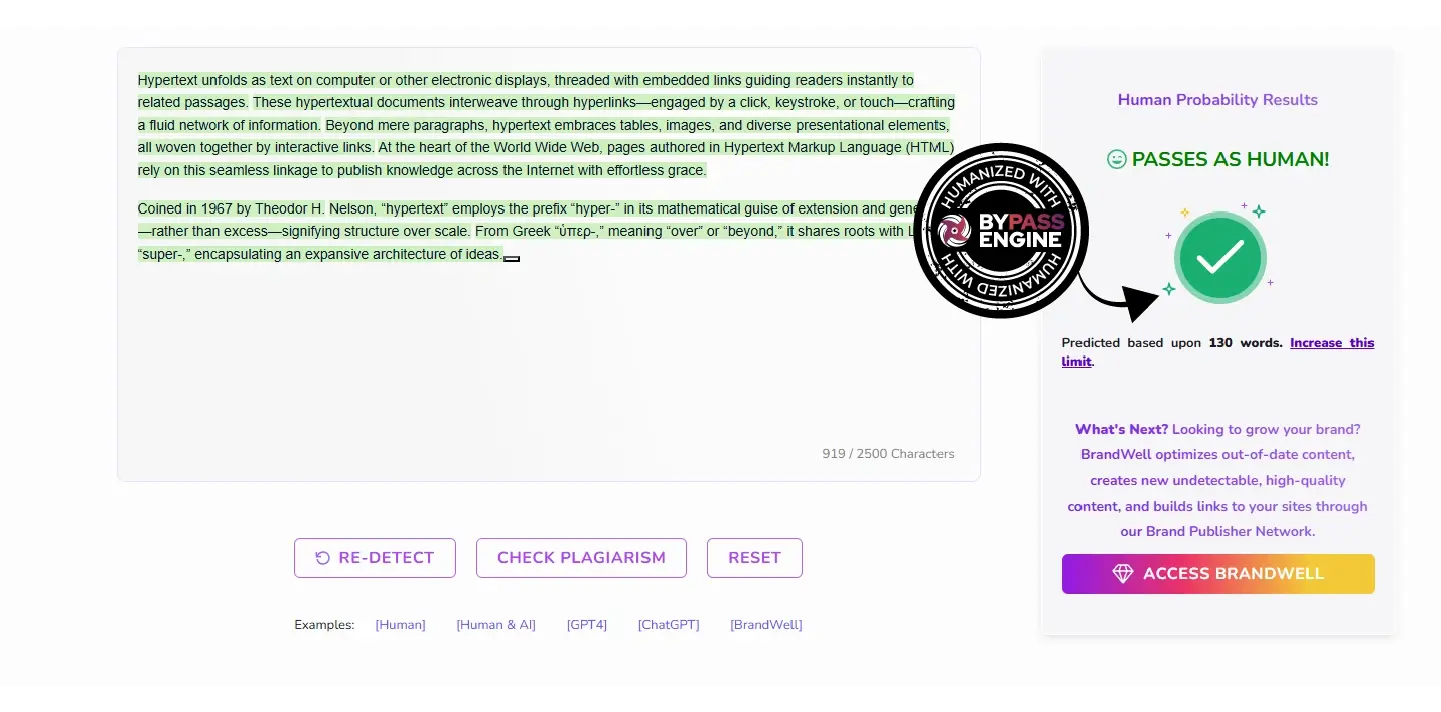
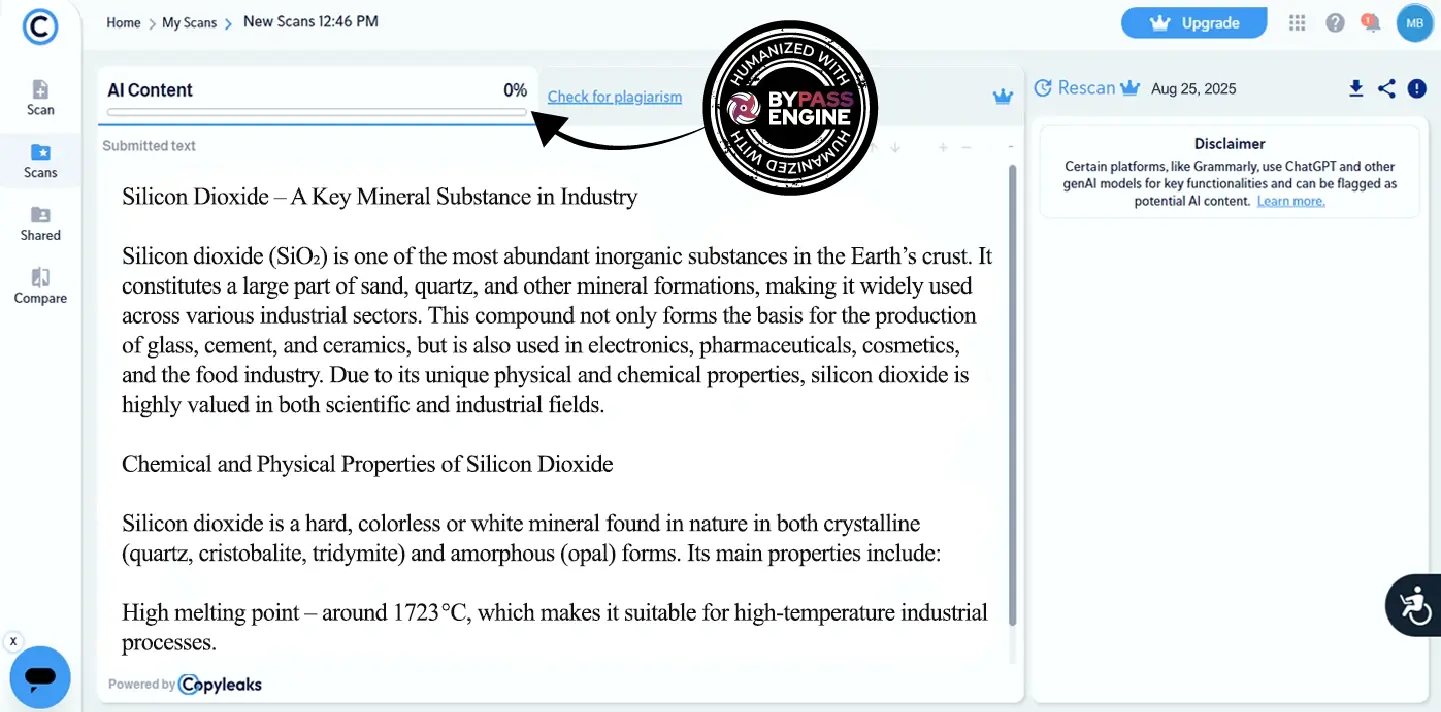
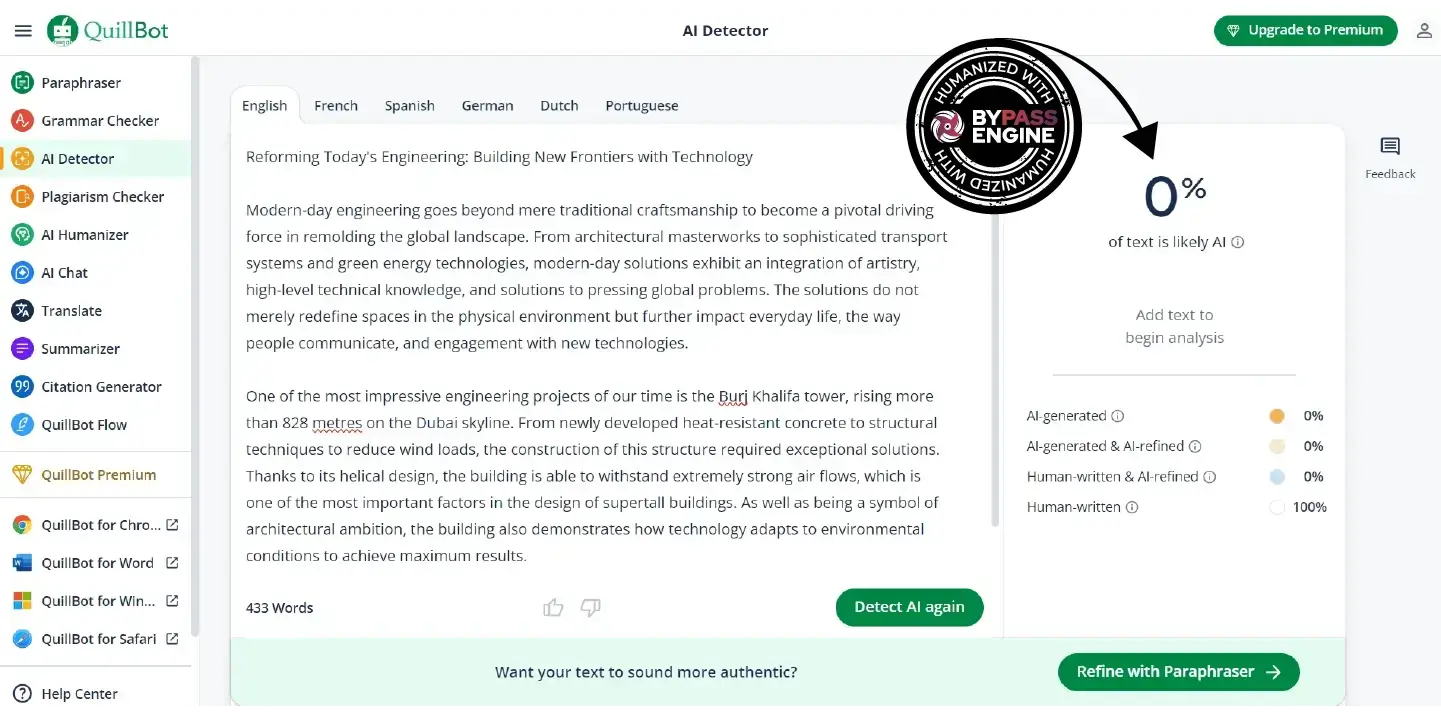
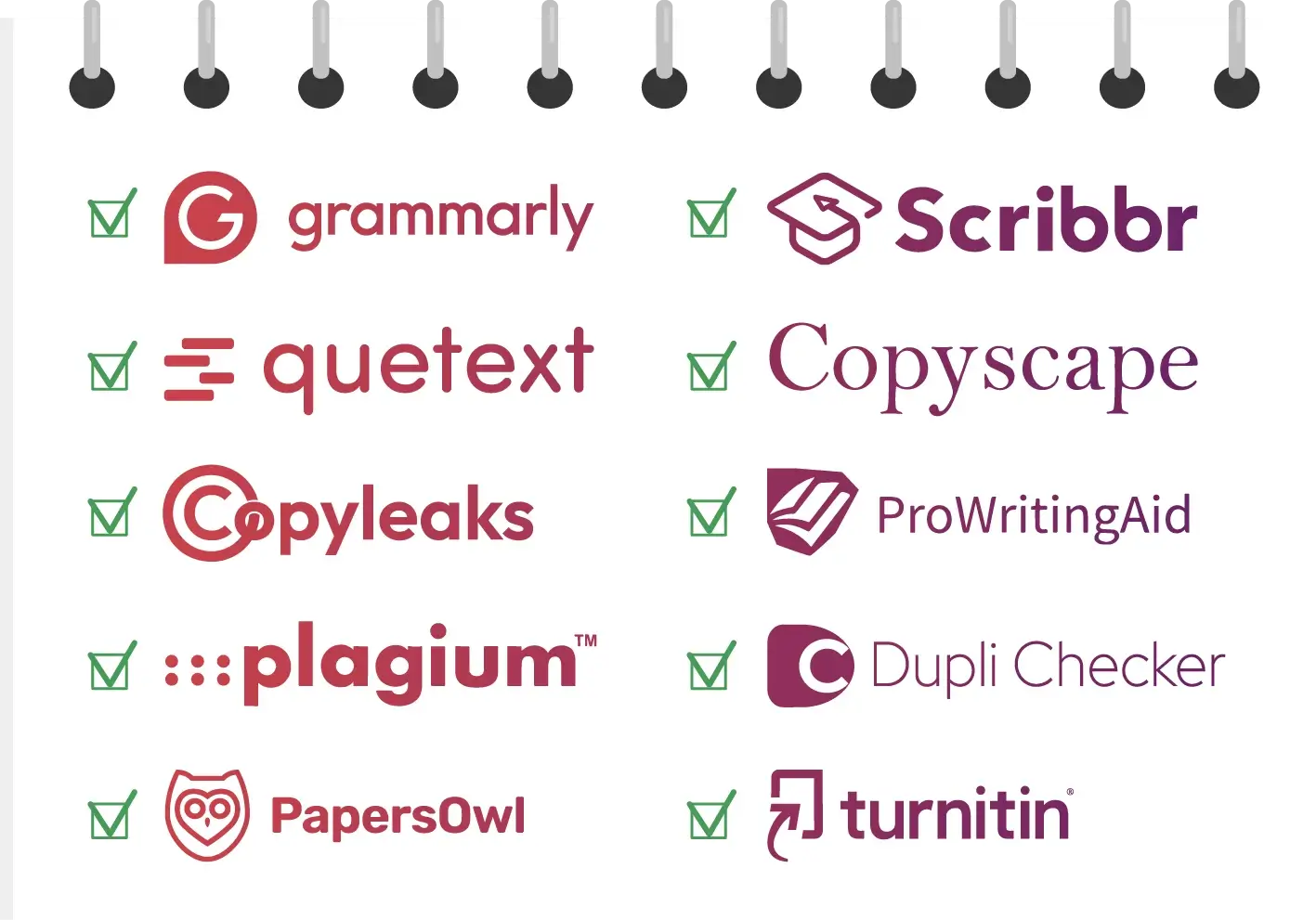
As AI-created content spreads, detection tools to identify it are also on the rise. These detectors, used by schools and businesses, check text for robotic patterns and odd phrasing. In answer to this, new tools have appeared—Anti-AI Paraphrasing Tools—aiming to keep originality while hiding signs of machine creation.

Try Bypass Engine – it’s on us!
Regular paraphrasing tools swap synonyms and slightly change sentences. Anti-AI paraphrasers go further. Their aim isn’t just to dodge plagiarism checks—but to transform AI-made content so well that it looks like a human wrote it, even when scrutinized by tools like GPTZero, Turnitin, or Crossplag.

The challenge? Achieving this while maintaining the original voice, tone, and message. Many stumble here, but Bypass Engine succeeds.



Try Bypass Engine – it’s on us!
The Bypass Engine doesn’t just change words. It shifts the whole context. With cutting-edge language models and insights from human behavior, Bypass Engine mimics how people think—not just how they speak. It adds small flaws, natural rhythms, and genuine word choices that match real communication. This makes the rewritten text not only hard to detect but also convincing.

The result: writing that feels like a person crafted it—because it uses human-like reasoning.

by Veronica
I was skeptical at first, but after testing...

I was skeptical at first, but after testing it against Originality.ai and GPTZero, BypassEngine’s Anti AI Paraphrasing tool consistently passed. Now I use it for all my website.
by Ethan
As an SEO, I need content that ranks but...
As an SEO, I need content that ranks but isn’t AI detectable. This Anti AI Paraphrasing tool hits the mark. My clients have no idea. Worth every penny.
by John J.
I used to stress over my essays getting flagged...
I used to stress over my essays getting flagged as AI-written, even when I did most of the work myself. BypassEngine’s Anti AI Paraphrasing Tool helped me paraphrase my drafts.
by Neil P.
My professor flagged my thesis draft...
My professor flagged my thesis draft as 60% AI-generated but t wasn’t. ChatGPT AI Hider tool paraphrase my paper and my professor never suspected a thing.
by Luke Phillips
Running 10 Shopify stores means creating...
Running 10 Shopify stores means creating a lot of product descriptions. AI speeds things up, but Google penalizes it. Bypass Engine Anti AI Paraphrasing Tool rephrases everything in a natural tone.
by Roger.
I’ve tried every bypasser out there...
I’ve tried every bypasser out there—StealthWriter, UndetectableAI & many others. Most just swap words awkwardly. Anti AI Paraphrasing Tool paraphrases my sentences like a real editor would!
for
students
Rewrite essays to bypass Turnitin and other detectors with ease.
for
marketers
Produce AI-assisted content that ranks without being flagged
for
researchers
Test AI detectors and generate untraceable academic summaries
for
copywriters
Transform AI drafts into content that feels written by you
for
developers
Transform AI drafts into content that feels written by you
for
journalists
Convert AI-generated notes into natural, publishable prose
for
authors
Polish AI-generated ideas into narrative-quality writing
for
AI research
Benchmark AI detectors using advanced bypass scenarios
95% of users content can be flagged with ai if Anti AI Paraphrasing Tool is not used.
Secure Payment:
Bypass Engine AI bypasser has helped a lot of students and professionals to optimize their workflow, be productive and get the most out of their time while achieving their goals.
Basic rewriters swap words and use fixed patterns, making them easy for AI detectors to catch. Bypass Engine, on the other hand, breaks down language structure and builds it anew. It tweaks metaphors, syntax, flow, and style—keeping your content engaging while avoiding detection.
This is why it’s different from other paraphrasing tools: it doesn’t just trick machines—it resonates with people.
Bypass Engine isn’t solely a tool for masking AI authorship; it’s also a gateway to creativity. Writers can begin with a basic AI draft and allow Bypass Engine to morph it into a seamless, natural piece that seems freshly written. It’s akin to having an extra brain that shapes your ideas while keeping your unique voice intact.
Whether you’re a student navigating strict originality rules, a marketer crafting captivating articles, or a novelist aiming to break free from a robotic tone—Bypass Engine boosts your authenticity.
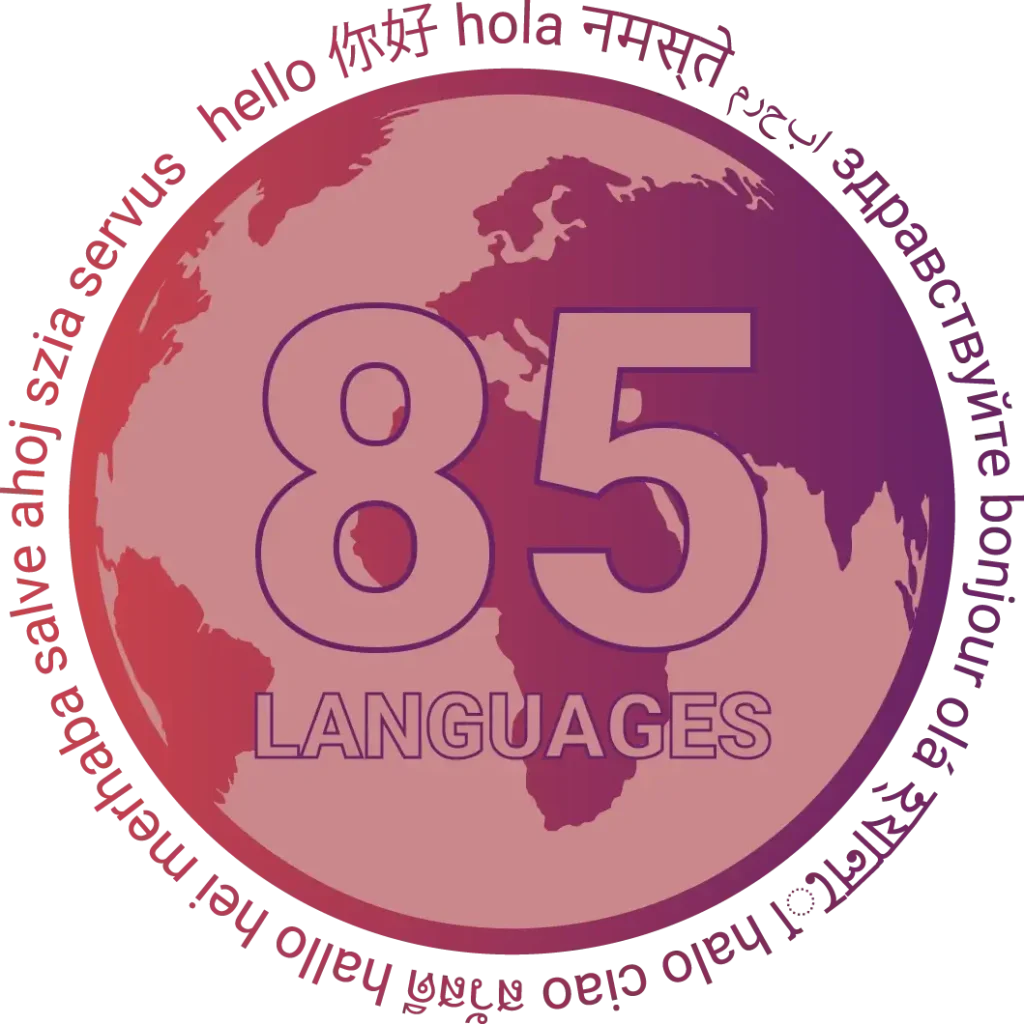
Bypass Engine is a multilingual Anti AI Paraphrasing Tool utility that rephrases essays and sentences across languages.
It supports 85 languages, including: Mongolian, Uzbek, Portuguese, Bashkir, Hindi, Kashmiri, Maithili, Romanian, Estonian, Welsh, Urdu, Oriya, Lithuanian, Hungarian, Kannada, Chinese, Pashto, Azerbaijani, Marwari, French, Belarusian, Slovene, Greek, English, Min Nan, Punjabi, Kyrgyz, Chhattisgarhi, Russian, Javanese, Vietnamese, Galician, Croatian, Dogri, Norwegian, Bengali, Armenian, Kazakh, Irish, Slovak, Finnish, Rajasthani, Catalan, Japanese, Serbian, Haryanvi, Awadhi, Santali, Danish, Faroese, Konkani, Bhojpuri, Brazilian Portuguese, German, Indonesian, Bashkir, Albanian, Montenegrin, Ukrainian, Maltese, Georgian, Malayalam, Macedonian, Arabic, Basque, Persian, Mandarin, Moldovan, Mandarin Chinese, Bosnian, Sinhala, Sindhi, Italian, Latvian, Sanskrit, Dutch, Korean, Czech, Malaysian and many more.
An Anti-AI Paraphrasing Tool takes content, especially from AI, and rewrites it to sound more human. It doesn’t just swap words but changes the sentence rhythm, structure, and tone to slip past AI detectors like GPTZero or Turnitin.
Bypass Engine doesn’t just switch words—it rebuilds the language flow using patterns from human writing. It mirrors natural quirks and contextual thinking, making it hard for AI scanners to spot and easy for humans to read.
Yes, Bypass Engine is designed to dodge common AI detectors. It rewrites content with subtle language that dodges patterns flagged by GPTZero, Crossplag, and Scribbr.
No, the main message and purpose of your text remain unchanged with Bypass Engine. While it adjusts wording and structure for a more natural flow, your original thoughts and reasoning are preserved.
Yes, as long as it’s applied responsibly. Bypass Engine is a tool that enhances clarity and tone. It shouldn’t be used to falsely claim authorship. Use it to polish, not deceive.
Bypass Engine crafts content that sounds natural, avoiding the repetitive and robotic patterns that can trigger Google’s detection systems. This can help your content perform better in search rankings and avoid penalties.
Yes, it can. A key strength of the Bypass Engine is how it keeps your voice intact. It looks at how you put sentences together and the words you use, making sure your unique style stays in the new text.
It’s super quick. Just pop your text in, pick your settings, and let it do its thing. You’ll get a version that sounds natural and human in just a few seconds.
Yes, it can. If your content didn’t pass AI detection, just put it into the Bypass Engine. It will tweak it to sound more natural and lower detection scores a lot—often turning 0% human scores into results labeled 90–100% human.
Definitely. Marketers, bloggers, fiction writers, teachers, and even customer service teams use it. Anytime you need content to sound truly human, the Bypass Engine adds value.
Yes, you are good there. Everything you put into the bypass engine stays yours. It’s not saved, shared, or reused, so your writing is safe, whether it’s for school, work, or just your stuff.
Students turn to Bypass Engine to make AI-assisted essays sound more human, ensuring they pass tough originality tests. Journalists use it to refine news briefs that sound too mechanical. SEO writers depend on it to craft content that feels natural and avoids Google penalties. Teachers utilize it to demonstrate revision techniques and writing flow in real situations. These aren't just rare instances—they represent the new standard in a world where AI and humans work together. As efforts to detect AI grow, the demand for content that sounds authentic is increasing.
We’re not battling AI—instead, we’re in a time where coexistence is expanding quickly. Bypass Engine and similar Anti-AI tools don’t promote dishonesty—they foster equilibrium. They allow users to blend AI’s efficiency with the genuineness of human expression. This way, tools like Bypass Engine act as creative partners—not mere shortcuts.
As more services implement AI-detection measures, the most innovative creators will turn to advanced tools—like Bypass Engine—to preserve originality, imagination, and, most importantly, trust.
In today’s digital age, content rules the internet. People want unique writing, but AI tools can spin articles fast. They twist words and jumble sentences to make something seem fresh. This is where anti AI paraphrasing tools step in. They check if writing is truly original. But why does this matter?
First, let’s think about trust. Readers crave genuine content. If they see the same ideas over and over, they lose interest. Websites want to stand out, not blend in with AI-made text. Anti AI tools help by spotting these spun articles. They shine a light on true creativity.
Secondly, there’s the issue of fairness. Writers spend hours crafting their work. AI can copy it in seconds. This seems unfair, right? Anti AI tools protect writers’ efforts. They make sure the hard work does not get overshadowed by quick AI tricks.
These tools also support better learning. Students using AI to do their work miss out on real learning. Anti AI tools push students to think for themselves. They encourage real learning and understanding.
Lastly, there’s the business angle. Companies want to rank high on search engines. Google loves fresh, original content. Anti AI tools help by keeping content real and unique. This boosts rankings and keeps businesses competitive.
In short, anti AI paraphrasing tools matter. They protect creativity, uphold fairness, support education, and boost business. As AI grows, these tools become even more crucial in keeping content genuine.
When searching for a reliable anti-AI paraphrasing tool, there are several key features to consider. First, accuracy is crucial. The tool must detect AI-generated text and not flag authentic human writing. The detection system should be sophisticated enough to recognize patterns typical of AI while allowing human creativity to shine through.
Next, ease of use is important. Users should navigate the tool easily, with clear instructions and a simple interface. The tool should not require extensive training or technical knowledge to operate effectively.
Speed is another vital factor. The tool should analyze text and deliver results quickly. This ensures that users can receive timely feedback and make necessary adjustments without significant delays.
Additionally, the tool should offer customization options. Users might want to set specific parameters or thresholds for detection, tailoring the tool’s sensitivity to their unique needs.
Compatibility with various file formats and platforms enhances the tool’s versatility. It should integrate smoothly with word processors, web browsers, and other writing applications to provide seamless functionality.
Moreover, privacy and security are essential. Users’ data and text should remain confidential, with strong safeguards in place to prevent unauthorized access.
Finally, regular updates and support are crucial for maintaining the tool’s effectiveness. As AI technology evolves, the tool should adapt, incorporating new detection techniques to stay ahead of AI advancements. Providing access to customer support ensures users can resolve any issues or questions promptly.
In a digital world where AI-generated content is becoming more common, the role of anti-AI tools is growing. These tools help keep content real and trustful. They work by finding AI-made text, showing where it’s not original. This helps creators keep their work unique.
Anti-AI tools use smart methods to catch paraphrasing tricks. They look deeply at text, spotting patterns and changes that seem off. By doing this, they help stop AI from taking over human creativity. This ensures that writers get credit for their ideas.
The digital landscape is changing fast. As AI grows, the need for authenticity rises. People want real voices and genuine stories. Anti-AI tools support this by acting as gatekeepers. They make sure that what we read and share is true to its source.
Looking ahead, these tools will be more important. They will keep improving to match the skills of AI. This ongoing battle will shape content creation and consumption. Writers and readers will rely on these tools to maintain trust in digital spaces.
In conclusion, anti-AI tools are key players in the future of content. They protect authenticity and help preserve the human touch in writing. As technology evolves, so will these tools, ensuring that genuine content stands strong.