
Generative AI includes tools like Claude, ChatGPT, or Google Gemini.
These are known for creating new content.
They take prompts and write answers.
But generative AI can also make things sound more human and rewrite content.
Let’s see how AI humanizers differ from AI rewriters and whether AI content detectors can find them.

Busy? Get the Key Points Fast!
- AI humanizers and rewriters work with big AI systems, such as Claude, ChatGPT, and Gemini.
- Humanizers make AI talk sound more relaxed and fun, like a human. Rewriters tidy up sentences.
- Both types of content, whether human-like or cleaned up, can be detected by a tool called Bypass Engine.
Humanizers vs AI Rewriters: How Are They Different?
Let’s look at these tools, how they’re different, and why people like them.
AI Humanizers
First up, we have AI humanizers. These tools try to make AI content sound cooler and more like a person wrote it.
Generative AI tools, which are very smart programs, help create this content.
But sometimes, what they write sounds too much like a machine – kind of dull.
Often, this AI-style writing needs a bit of flair to make it more fun to read. Instead of fixing it yourself, some tools say,
“Hey, we’ll do it!” They use the same smart programs that made the dull stuff to try and make it better.
But here’s the thing – it doesn’t always work perfectly, which we’ll talk more about soon.
AI Helpers
AI helpers can tidy up writing, correct grammar, and improve style.
They’re more versatile than AI “humanizers.”
They help make writing friendly or serious. However, they’re not flawless. Sometimes, the writing can turn out dull.
Can AI catch AI writing?
We need to see if AI tools can find content created by AI.
For this test, we used ChatGPT to write an article, all done by AI.
Here’s what we asked:
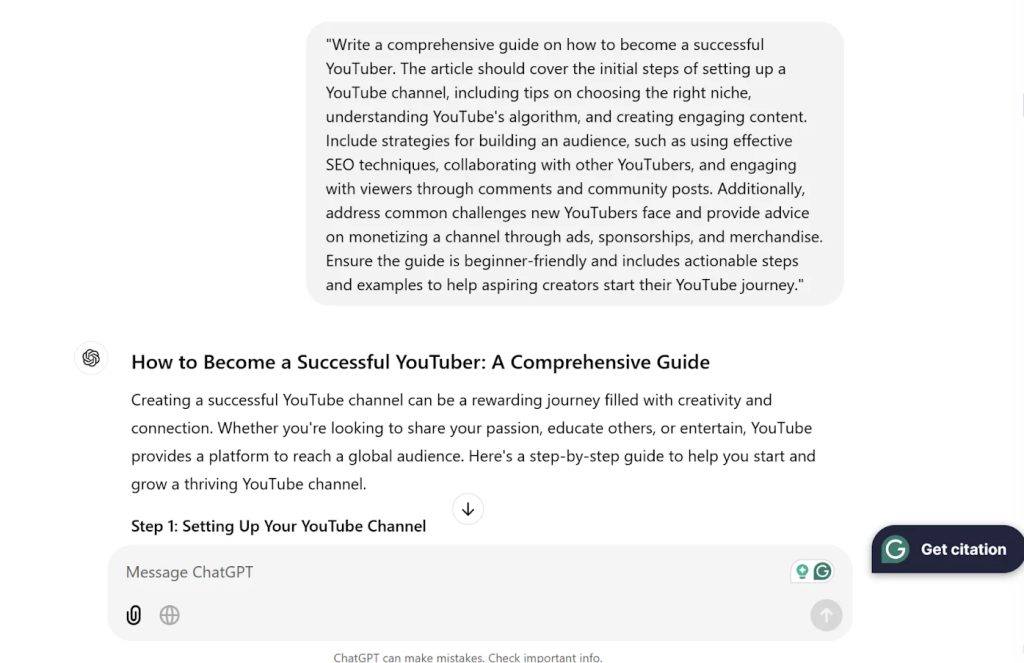
The Bypass Engine tool is very sure—it’s 100% confident that the ChatGPT text is AI-made.
AI Humanizers
Let’s try Humbot for our test. It’s a popular tool that makes AI sound more human.
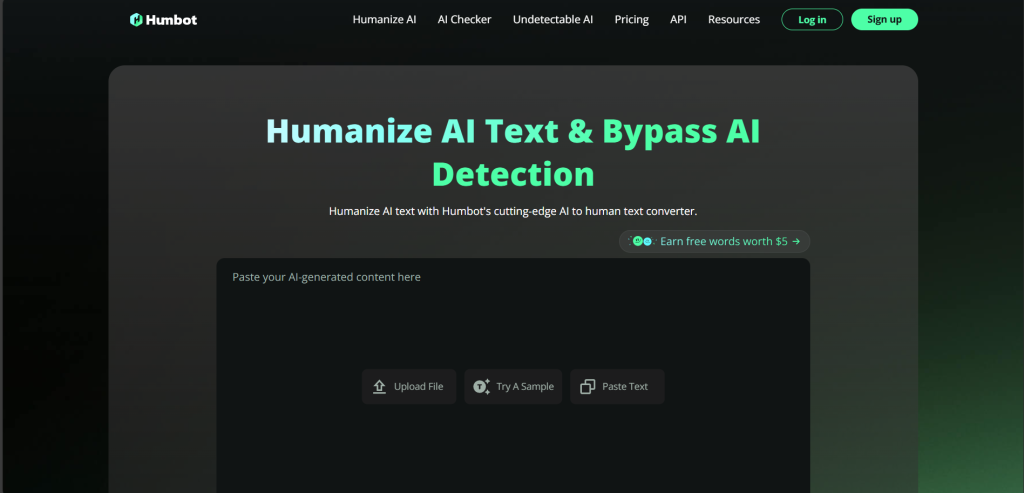
Next, we’ll see how text looks after Humbot makes it seem more human.
Then, we can test it with our AI checker.
The Bypass Engine checker thought the text, which sounded like a human wrote it, was probably made by AI. They were sure.
A quick look at what these tools offer shows a big problem:
The text had mistakes, like random big letters and bad grammar.
Some tools use bad grammar to trick people and avoid detection.
But really, it just jumbles the words and makes the sentences unclear.
About AI Revision Tools
Have you thought about AI tools that change text? Do they work better? Let’s see an example from YouTube again. But this time, we’ll use the Ahrefs tool to change a paragraph made by ChatGPT.
Now, let’s check the version in Bypass Engine. The AI Detector from Bypass Engine was sure the text was made by AI. Looking at the results, Ahrefs’ work was clearer than Humbot AI’s. But, Bypass Engine could tell with 100% certainty that it was likely made by AI.
AI Humanizers vs. AI Rewriters: Practical Uses & Applications in Different Industries
AI Humanizers
Let’s explore how AI humanizers are used in industries. These systems add empathy, naturalness, and personality to complex machine codes.
1. Customer Service: In customer service, businesses use AI to help teams with chatbots that learn for better personalization.
2. Content Creation: Marketers use AI tools to create content like social media posts and newsletters, matching a skilled writer’s quality but faster and more.
3. Healthcare Sector: Therapy apps use algorithms to act like therapists, giving mental health users personal advice.
4. Education Industry: Developers make learning tools that study student patterns to find their needs and challenges.
5. Manufacturing Sector: Manufacturers use cobots, robots that work with humans, to boost productivity and safety by predicting accidents.
AI Rewriters
AI rewriters are changing how we handle text. They help in many fields:
1. Publishing: They turn complex papers into easy articles, helping people understand topics like climate change.
2. Law: They make legal texts simple, so people can understand tough laws better.
3. Medicine: They simplify reports, helping pharmacists with drug details for better care.
4. Tech Writing: They make manuals clear, so everyone can use tech products easily.
5. Creative Writing: New writers use them to make catchy ads and slogans.
Here’s what I think. AI humanizers are changing how we see ‘machine-like’ replies by adding empathy and professionalism in areas like customer service, content creation, healthcare, and education.
On the flip side, AI rewriters create messages that fit different audiences, whether it’s legal terms or manufacturing guides, making things easier to understand.
These uses are different but share a goal: to ensure smooth communication, even if it’s from smart machine code made for unique user needs. Supporting future growth and teamwork can push this tech’s limits, taking us to new heights. Let’s welcome both with open arms as we build this tech-filled story together!
AI Humanizers vs AI Rewriters

AI humanizers and rewriters are different, but both have a common trait – their work seems like it’s done by AI. These tools can be useful in some cases, yet they shouldn’t replace human writers. For the best results, use these tools sparingly and as a support, not as the main writer.
AI Humanizers vs. AI Rewriters: Clearing Up Misunderstandings
When we look at content creation’s future, AI, or artificial intelligence, always comes up. But some wrong ideas about AI tools remain, especially those that make our writing sound natural and those that help rewrite text. Knowing these tools better can help us use them right.
Misconception 1: All AI text tools are alike
Some people believe that AI tools for natural language and rewriting are the same. They aren’t. Natural language AI tools make text sound real, like a casual chat. Rewriting tools change text to make it clearer and flow better.
Misconception 2: AI tools replace humans
AI tools can improve text by fixing grammar and making it easier to read, but they can’t take over completely. People need to guide them to ensure the text meets specific goals, fits a brand’s voice, and carries subtle meanings.
Misconception 3: AI tools make perfect content
Some think AI tools can instantly create flawless text. In truth, you often need to polish what AI produces. Natural language tools may make text too casual, while rewriting tools might produce text that feels stiff.
Misconception 4: AI-written text is easy to spot
Another myth is that AI text is always obvious. Today’s AI can mimic human writing well, making it hard for detection tools to spot. However, if the AI uses repetitive structures or odd phrases, it can reveal itself.
By understanding these misconceptions, people can use AI tools for natural language and rewriting more effectively. They can leverage AI strengths while adding a human touch to create polished content.
AI Humanizers vs AI Rewriters: Common Questions
Can they boost website visits?
Using AI Humanizers or Rewriters may not help increase visits.
Google might flag this content as spam, leading to penalties for your site.
Should you edit AI-generated work?
Yes, always review and enhance AI output, like from ChatGPT.
This ensures the content matches your brand and is valuable to readers.