
AI is changing schools. Tools like ChatGPT help learning but raise cheating worries. Students use AI more now. Schools need AI detectors to keep things fair.
This piece looks at AI detectors in schools. It explains how they work, which ones are common, and their limits. Schools must balance new tech with honesty, so knowing about AI detection is key now.
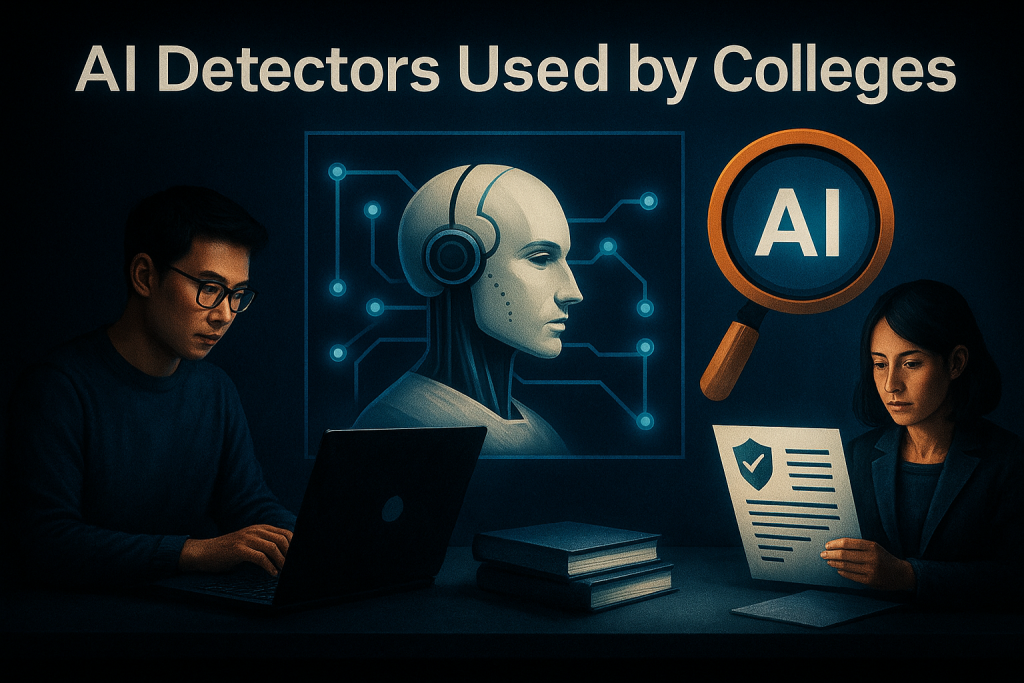
The Rise of AI Writing Tools in Education
AI writing tools have grown fast lately. Tools like ChatGPT, Sudowrite, and Copy.ai help with tasks like brainstorming, summarizing, and writing essays. They boost productivity but make it hard to tell student work from AI-made content.
Teachers find it tough to spot this mix. Colleges use AI detectors to check if work shows real understanding or is machine-made. This is crucial not just for grades but also for academic honesty.
What Are AI Detectors and How Do They Work?
AI detectors look for text patterns to see if AI wrote something. They check different things like:
- Perplexity: A measure of how predictable a sentence is. Human writing tends to have more variation.
- Burstiness: The distribution of sentence lengths and complexity. Human writers vary their tone more than AI.
- Token probability: Examining word choice and sentence structure common in AI-generated text.
Colleges use AI detectors that spot if text is from a human or AI. These tools either work with school systems or as separate scanners.
Top AI Detectors Used by Colleges
Here are the most common AI detectors used by colleges today:
1. Turnitin AI Detection
Turnitin, a leader in spotting plagiarism, now also finds AI-written text. Its new tool marks parts that seem AI-made, showing these separately from usual plagiarism results.
2. GPTZero
GPTZero helps teachers find AI-written text. It’s quick and online. It shows how sure it is and highlights the AI parts.
3. Originality.ai
Designed for teachers, writers, and SEO experts, Originality.ai spots plagiarism and AI use. Its smart detection system is often updated to match new AI content.
4. Copyleaks AI Content Detector
This tool can spot many languages. It checks text in different languages. This helps global groups a lot.
5. AI Text Classifier by OpenAI
Some schools used OpenAI’s tool. But, it wasn’t reliable. Now, many colleges use other tools.
Accuracy and Limitations of AI Detectors
AI detectors in colleges aren’t perfect. They might wrongly tag real student work as AI-made, especially if it’s well-written. Also, slightly changed AI work might not get caught. This makes it hard for teachers to judge flagged work fairly. Wrongly blaming students can hurt trust and well-being, while missing dishonest work lets cheating go on. Colleges want more steps in reviewing before punishing students.
Ethical Considerations in AI Detection
Ethics play a pivotal role in the discussion surrounding AI detectors used by colleges. Key concerns include:
- Privacy: Is it ethical to run student work through third-party tools that store or analyze their data?
- Consent: Should students be informed or give permission before their work is analyzed by AI detectors?
- Transparency: Institutions must clearly communicate how AI detection works and what the implications are for students.
Colleges are fixing these worries by letting student councils help make rules and giving choices to opt out in certain cases.
Institutional Policies and Guidelines
Colleges are changing rules because of AI writing. They’re saying using AI to help write, without telling, is like cheating.
Guidelines typically require students to:
- Disclose the use of AI tools in assignments
- Limit AI use to specific approved tasks (e.g., grammar checks)
- Submit original reflections alongside AI-supported content
Colleges now use AI detectors in their new rules. These tools help enforce penalties when rules are broken.
Impact on Students and Learning
AI detection changes how students act and think. Some students avoid AI tools because they’re scared of being wrongly flagged. Others use them carefully for ideas or editing. This fear can make students anxious. They worry their own work might look like it’s made by a machine.
This fear can also stop creativity. Instead of banning AI tools, experts say we should teach students to use AI wisely. AI detectors in colleges should help guide students, not punish them, and be part of learning about digital tools.
Legal Implications for Educational Institutions
Colleges need to be cautious with AI detectors due to privacy laws like FERPA and GDPR. These tools handle sensitive data, requiring careful use.
- Consent protocols must be established
- Data storage policies must comply with local and international regulations
- Students should have access to contest or appeal detection outcomes
Therefore, AI detectors employed by colleges must be evaluated not only for their accuracy but also for regulatory compliance and liability safeguards.
Case Studies – Colleges Adopting AI Detectors
Some colleges use AI detectors with mixed results:
University of California System
Teachers got tools like GPTZero and Turnitin’s AI. At first, students pushed back. But then, they liked having clear AI rules.
McGill University, Canada
AI detectors were tested with an honesty pledge. The aim was to teach about AI, not to punish.
University of Sydney, Australia
Implemented Copyleaks for finding copied content in many languages. It worked well in ESL courses.
Schools used the tech to match their culture, focusing on openness and help, not spying.
Alternatives to Detection – Promoting AI Literacy
Experts say instead of just using detection, we should teach students to use AI wisely.
Strategies include:
- Prompt Engineering Workshops: Help students understand how their inputs affect AI outputs.
- AI Disclosure Assignments: Encourage students to reflect on how they used AI in their work.
- AI Ethics Courses: Introduce the societal impacts of AI and guide students on ethical usage.
This cuts down the work for AI detectors in schools and helps students get ready for jobs where AI is everywhere.
The Future of AI Detectors in Academia
AI detection technology is rapidly evolving. The future likely includes:
- Deeper LMS Integration: Tools like Turnitin or GPTZero will be built directly into platforms like Canvas or Moodle.
- Real-Time Feedback: Students may receive AI feedback instantly, promoting self-correction.
- Hybrid Evaluation Models: Combining AI detection with human grading and oral exams to verify understanding.
In the future, we might focus less on catching cheaters and more on making strong systems. These systems should be open about AI help and follow good ethics.
Conclusion
AI detectors in colleges are changing how we think about honesty in school. They’re more than just tools to catch cheating; they help build a new way of learning that includes using tech wisely and making smart rules.
By knowing how these tools work, what they can’t do, and how to use them right, colleges can create a fair and modern place to learn. The goal is not to stop using AI but to use it well, clearly, and with students working together in learning.
FAQs – AI Detectors Used by Colleges
1. Are AI detectors accurate?
Colleges use AI detectors that work well, but they aren’t perfect. They can still make mistakes, especially when content mixes human and AI writing.
2. Do all colleges use AI detectors?
Many top schools use AI detection tools to keep academic honesty.
3. Can students appeal AI detection results?
Yes. Most colleges have a way for students to appeal if they disagree with AI-related charges.
4. What’s the best way to avoid being flagged by detectors?
Create your own content and mention any AI tools that helped you. Don’t turn in work that’s entirely made by AI.
5. How are AI detectors evolving?
They’re becoming more accurate, multilingual, and integrated into educational platforms, with better transparency and real-time feedback features.