
Sometimes, even our AI detector gets it wrong and flags genuine work as AI-produced. This can be frustrating for creators of original content. Whether you’re a student incorrectly flagged by TurnItIn or GPTZero for using ChatGPT, or a writer who gets a false alert from Bypass Engine, these mistakes can be quite distressing.

Even our AI detector isn’t flawless, and it might show false positives. These mistakes can be tough for anyone making original content. If you’re a student wrongly accused by TurnItIn or GPTZero of using ChatGPT, or a writer flagged by Bypass Engine, this guide is for you.
Learn how AI detection functions, its accuracy levels, what to do if you’re wrongly accused, and tips to prevent it in the future.
This article gives a quick look at common questions about false positives in AI detection, which might help if you’re accused of using AI. For more detailed info on each topic, check the suggested reading links in the sections.
What to Do if You’re Wrongly Accused — As a Student
If you’ve written something on your own and are wrongly accused of using AI, here’s how to handle it:
1. Try different AI detectors. Use various models that fit your school’s policy.
2. Stay calm. A quick reaction might worsen things. Take your time to respond wisely.
3. Gather all necessary information.
4. Look over your school’s rules about AI use and honesty.
5. Collect notes and drafts showing the effort you put into your work.
6. If you used Google Docs, use the Bypass Engine Chrome extension to show the creation process.
7. Find info on the accuracy and errors of detection tools.
8. Compare with your previous work to show consistency.
9. Understand your professor’s side — they want to uphold academic honesty amid rising AI misuse.
10. Write a respectful response to your teacher with the evidence you gathered, explaining it’s a false positive.
11. If needed, take the issue to a higher authority at your school if your teacher doesn’t resolve it.
What to Do if You’re Wrongly Accused — As a Writer
If you’re a writer wrongly accused of using AI to create content, here’s what you can do:
1. Test with various AI detectors. Different models might align better with your needs.
2. Collect all relevant information to support your case.
3. Check if your contract mentioned any AI usage restrictions.
4. See if there was an agreed-upon AI detection score or tool (not the best strategy to prevent AI misuse).
5. Take similar past work and check it with an AI detector.
6. Offer insights on AI detection accuracy and how to interpret scores (consult AI Detection Accuracy guides).
7. Share your findings with the person accusing you to clear up any misunderstandings.
8. Prove your other work is original to back your claim.
9. Show how you created the content, using tools like the ChatGPT detector Chrome extension.
10. Provide studies on AI detection accuracy and how to use detection scores effectively.
How to Avoid False Positives
Here are some tips to help prevent and resolve false positives.
1. A detection score showing 60% Original and 40% AI isn’t a false positive. It means there’s 60% confidence the content is Original. It’s not about 60% being Original and 40% being AI; it’s about the confidence level.
2. Try to create all articles in Google Docs if you can. This way, you can use our free Chrome Extension to show your content is Original.
3. Editing content written by AI isn’t a false positive; it’s a true positive.
4. If AI edits your work, it’s not a false positive; it’s a true positive.
5. If AI touches the content in any way, it might cause the whole article to be flagged as AI.
6. “Cyborg” writing, using a lot of AI tools for outlines, edits, and optimization, can lead to a higher AI score.
7. That’s why we made a free content optimizer tool, like SurferSEO or MarketMuse, but it’s 100% free and doesn’t use AI, to lower the chance of a false positive.
8. Weird formatting can mess with the accuracy of detector tools, causing more false positives or negatives.
9. The shorter the text, the less accurate the detection score. We suggest checking at least 100 words.
False positives in AI detection are significant issues and won’t disappear with generative AI. As AI usage rises, we aim to help readers grasp detection tools’ limits and share tips on using them wisely and proving your work’s originality.
What is AI Content Detection?
An AI content detector is a tool using artificial intelligence. It distinguishes between text created by AI and text written by humans, even when the differences are subtle.
How does our AI Detector work?
Common Misunderstanding:
If you see a detection score showing 60% AI and 40% Original, it means there’s a 60% chance that AI created the content. It doesn’t mean 60% of the text is from AI and 40% is from a human.
Understanding AI Detection Scores:
If a score shows 60% Original and 40% AI, and you know you wrote all of it, it’s not a mistake. It correctly sees the content as Original.
How Reliable Are AI Detectors?
AI detectors don’t get everything right, and they never will. We’ve looked closely at how well Bypass Engine works, and its accuracy changes depending on the AI tool and language model used to make the content.
Our newest model, Lite 1.0.1, is over 99% accurate with a 0.5% chance of mistakes. Lite allows small edits from AI, like using Grammarly for spelling, making it great for web publishers, marketers, and teachers.
In October 2024, we launched a Turbo model with over 99% accuracy and less than 3% mistake rate. It’s perfect if you want no AI use at all.
For more details, check out the full AI Detection Accuracy Study.
Also, look at a meta-analysis of eight studies showing Bypass Engine’s top-notch AI detection.
Try our AI content checker here.
Check our complete AI detector accuracy tests here.
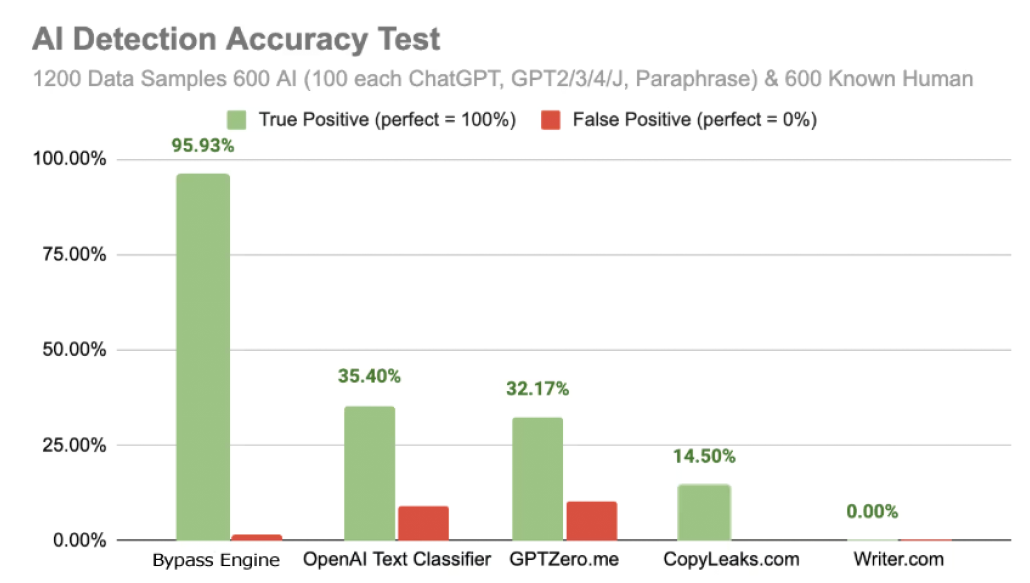
Bypass Engine’s accuracy on GPT-4
Here’s a brief look at how well Bypass Engine performs with GPT-4 compared to other AI detection tools (note, this used an older model).
To check the accuracy of an AI detector, we used a confusion matrix. It compared AI-generated text with human-written text.
- True Positive: The detector correctly saw the content as AI.
- False Negative: The detector wrongly thought AI content was human.
- False Positive: The detector wrongly thought human content was AI.
- True Negative: The detector correctly saw human content as human.
Are AI Detectors Easy to Fool?
Many AI detectors can be tricked quite easily. You can bypass them by using a paraphrasing tool, such as Quillbot, to change some words. However, Bypass Engine stands out because it can tell if the content is created by AI, original, or paraphrased.
- Accuracy of AI Detection
- Is it possible to make AI-generated writing undetectable?
- Spotting Use of Paraphrasing Tools like Quillbot
What is and isn’t a false positive?
When an AI detector mistakenly thinks human-made content is AI-generated, it’s called a false positive.
People often get confused about false positives. Let’s clear it up. Here’s how Bypass Engine tells AI content from original content in different situations:
– If AI writes it and no edits are made, it’s AI text.
– If AI writes it and a human edits it, it’s still AI text.
– If a human writes it but AI edits it a lot, it’s AI text.
– If AI outlines it, a human writes it, and AI edits it a lot, it’s AI text.
– If a human writes it and AI lightly edits it, results depend on how much AI edited it.
– If AI helps with research and a human writes it, it’s human-made.
– If a human writes it and edits it, it’s human-made.
An AI outline involves using a language model to develop a content idea, conduct research, or create a framework. The extent to which AI is utilized can vary, and this might influence whether the text is identified as AI-generated or human-created.
If an AI outlines the content, a human writes part of it, and then AI edits or expands it, Bypass Engine tries to flag it as AI-made. This is considered a correct identification.
In a similar vein, if ChatGPT writes something and a person thoroughly edits it, but it’s still marked as AI-generated, this is also a correct identification.
Is AI editing considered AI or original work?
This is a complex issue that people are still discussing as AI usage grows. Our Lite 1.0.1 model allows for some AI editing, like using popular tools such as Grammarly for spelling and grammar checks during editing.
In general, it’s important to be open about using AI, whether it’s for planning content or editing.
How Should AI Detectors Be Used?
In a world where false positives will never be completely eliminated, how should we utilize AI detectors?
AI detection doesn’t offer proof for each text, so no tool can claim with certainty that a piece was created by AI.
Therefore, it’s wiser not to enforce a strict rule that every text must hit a specific threshold. Instead, review multiple articles from the same author to spot those likely using AI versus those who aren’t. Many users of Bypass Engine have successfully identified AI-generated content this way, even when writers were asked not to use AI. These users felt confident ignoring suspected false positives.
Check out case studies of Bypass Engine customers who have succeeded.
For academic discipline, relying solely on AI detection scores isn’t sufficient.
- How to Think About AI Detection Scores
If Detection Scores Aren’t Flawless, Why Use Detection Tools At All?
Some people wonder if having an AI detection tool is wise if it isn’t perfect. At Bypass Engine, we trust our test detection rates and the extra measures we’ve taken to minimize false positives, like the free tools we provide.
In a world where AI content runs loose without checks, many of us would feel the effects.
- For web publishers, if you’re worried about sticking to Google’s rules with AI-made content, remember that using AI to boost search rankings breaks Google’s spam policies. AI detectors can help keep your site safe. If you’re okay with using AI content, you don’t need detectors or pricey writers.
- For content marketing agencies, not using AI detectors makes it tough to assure clients that content isn’t AI-made.
- For writers, without AI detectors, you might find yourself up against many ChatGPT users, trying to show how valuable your work is.
- In academia, if AI use isn’t controlled, it can lessen the value of degrees.
AI tools like ChatGPT and HuggingChat are here to stay. Writers need to embrace this change.
Numerous Cases of Students Wrongly Blamed for AI Use
The advent of ChatGPT and AI detection tools has caused some unfortunate incidents in schools.
Consider these instances:
“A professor wrongly claimed I used chatgpt to write my paper.”
“A teacher mistakenly accused me of using ChatGPT for an assignment.”
It’s important to note that at Bypass Engine, we believe an AI detection score alone shouldn’t lead to penalties. If there’s a suggestion of AI use, always examine the work thoroughly and individually.